
You are the only security person at a company of a few hundred people. SOC 2, vendor questionnaires, vulnerability tickets, access reviews and the odd incident all land on you, and the list grows faster than you can clear it. The work is spread across too many tools, and there is more manual follow-up than one person can carry.
A security team of one works by keeping the decisions only you can make and giving everything else a clear owner: IT, engineering, a fractional CISO, an outside provider or a tool.
This guide covers what to own, what to drop, what to hand off and to whom, when to hire and a weekly plan you can stick to.
What does a security team of one actually own?
A security team of one owns the decisions nobody else can make: which risks matter most, the security roadmap, incident command, policy ownership, and the relationship with auditors and leadership. Most execution, such as patching, access changes and evidence collection, can sit with IT, engineering or outside help, as long as you set the standard and check the result.
Why each decision stays with you:
| Decision | Why it stays with you |
|---|---|
| Which risks matter most | It needs context on the business, not just the tools |
| The security roadmap | Someone has to say no to good ideas so the important ones get done |
| Incident command | In an incident, one person must make calls quickly |
| Policy ownership | Policies set the rules everyone else follows |
| Auditors and leadership | They need one accountable voice |
In practice, you set the standard and check the result. For patching, you decide the rule, such as critical fixes on internet-facing systems within an agreed number of days. IT or engineering does the patching. You check that it happened.
Incidents follow the same split: you hold incident command; IT and engineering execute, such as isolating a machine once you approve it; legal and leadership decide on notifications and external communication; an MDR or MSSP provider, if you have one, watches and investigates alerts. The ransomware response plan shows these roles hour by hour.
How do you prioritize security work with limited resources?
Prioritize what would hurt the business most and what customers or auditors already require: identity and MFA, internet-facing vulnerabilities, tested backups, logging, and your compliance commitments. Rank the rest by risk reduced per hour of effort, cap reactive work each week, and write down what you are deliberately not doing so leadership sees the tradeoff.
CISA's Cyber Essentials guide for small businesses advises multifactor authentication (MFA) for all users, starting with privileged, administrative and remote access accounts.
For vulnerabilities, a CVE is a public ID for a known software flaw. You can't read them all: Jerry Gamblin's 2025 CVE Data Review counts 48,185 CVEs published in 2025, about 132 a day. Narrow the list with CISA's Known Exploited Vulnerabilities catalog, or KEV, which lists flaws confirmed to be exploited in the wild. A KEV entry on an internet-facing system goes to the top.
Rank the rest with one question: how much risk does this remove per hour of my time? If turning on a single sign-on policy takes an afternoon and covers every app, it beats a week spent hardening one internal tool.
Then cap reactive work. Pick a limit, for example a 30-minute daily triage window plus one batched afternoon, and protect the rest of your week.
What should a solo security lead keep, drop or hand off?
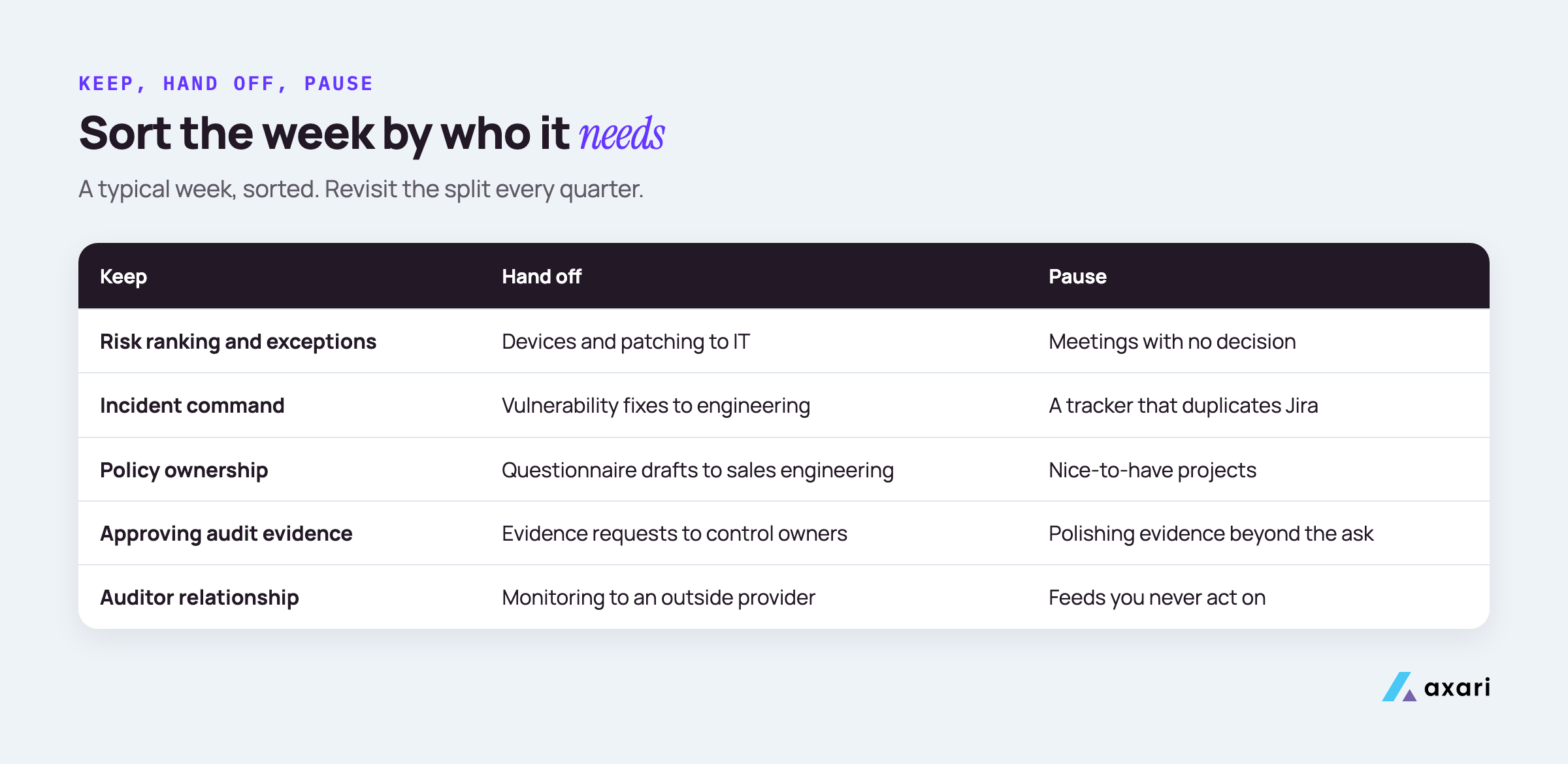
Keep risk decisions, incident command, policy and the audit relationship. Hand off execution: patching and devices to IT, vulnerability fixes to engineering, first drafts of vendor questionnaires to sales engineering or a tool, and alert monitoring to an outside provider. Pause work no customer, auditor or real risk requires, and revisit the split every quarter.
A test for each task:
- Does it need your judgment? Keep it.
- Does it need hands on a system? Give it to the team that owns that system.
- Is it mostly reminders, routing and paperwork? That's coordination work. Hand it to a person or a tool that will carry it reliably, with you approving what matters.
- Does nobody require it? Pause it and say so.
Applied to a typical week at a hypothetical 250-person fintech:
| Keep | Hand off | Pause |
|---|---|---|
| Risk ranking and the exception process | Device management and patching to IT | Meetings with no decision to make |
| Incident command | Vulnerability fixes to engineering | A personal tracker that duplicates Jira |
| Policy ownership | Questionnaire first drafts to sales engineering | Nice-to-have projects |
| Approving audit evidence | SOC 2 evidence requests to each control owner | Evidence polish beyond the request |
| Auditor relationship | Alert monitoring and investigation to an MDR provider | Feeds you never act on |
| Vendor tiers and recommendations | Each vendor decision to its risk owner | Full questionnaires for low-tier vendors |
Customer security questionnaires mostly repeat, so someone else can draft answers for your review; see how to answer security questionnaires faster. For the SOC 2 row, SOC 2 evidence collection for a lean team shows what still needs a human. For vendor reviews, you set the tiers and recommend, and the risk owner decides; vendor security assessment lays out the process.
What security tasks can you stop doing?
You can usually stop custom reports nobody reads, manual screenshots your GRC platform already collects, deep triage of low-severity findings on systems with no exposure, and tool evaluations without a funded problem behind them. Stop them openly: tell your manager what you are dropping, why the risk is acceptable, and when you will revisit the decision.
A GRC platform (governance, risk and compliance), such as Vanta or Drata, connects to your cloud and identity tools and collects much of your audit evidence on its own. If you still screenshot settings it already checks, you can take that time back.
Saying it out loud turns a dropped ball into a decision. A short, hypothetical note to your manager:
I'm pausing manual review of low-severity findings on internal-only systems until Q3. They have no internet exposure, and the time goes to our SOC 2 gaps instead. I'll revisit at the next quarterly review.
A note like this also shows leadership, in writing, what one person can and can't cover.
How do you hand off vulnerability remediation to engineering?
Hand off remediation by making it engineering's planned work: route each finding to the owning team's backlog with severity, the affected service, a fix hint and an agreed SLA. Engineering owns the fix and the date; you own the standard, the exception process and verification. Confirm closure by re-checking the scanner rather than trusting the ticket status.
An SLA, or service level agreement, is the agreed time to fix. Set the numbers once with engineering leadership, by priority tier (P1 to P4), and write them down. The clock starts at detection, and an SLA counts as met only once the fix is verified.
A ticket engineering can act on has five things:
- The service and its owning team, so it lands in the right backlog.
- Severity in plain words: what an attacker could do, alongside the score.
- A fix hint, such as the package version that resolves it.
- The agreed date, from the SLA.
- How it will be verified, usually a rescan from Snyk, Wiz or Qualys.
Sometimes a fix has to wait. Let teams request an exception with a reason, compensating controls and an expiry date. You run the process; a named risk owner or executive sponsor approves it, and you review open exceptions quarterly. The standard holds, and you don't become the bottleneck.
Verification is the step teams skip most often. A ticket marked done means someone believes it is fixed. A clean rescan shows that it is.
Who owns what between IT and security?
In a small company IT usually executes and security sets the rules: IT runs devices, identity administration, patching and onboarding, while security defines policy, reviews access, runs the risk acceptance process and tests the controls. Write the split as a RACI with exactly one accountable owner per task, and revisit it after every audit or reorganization.
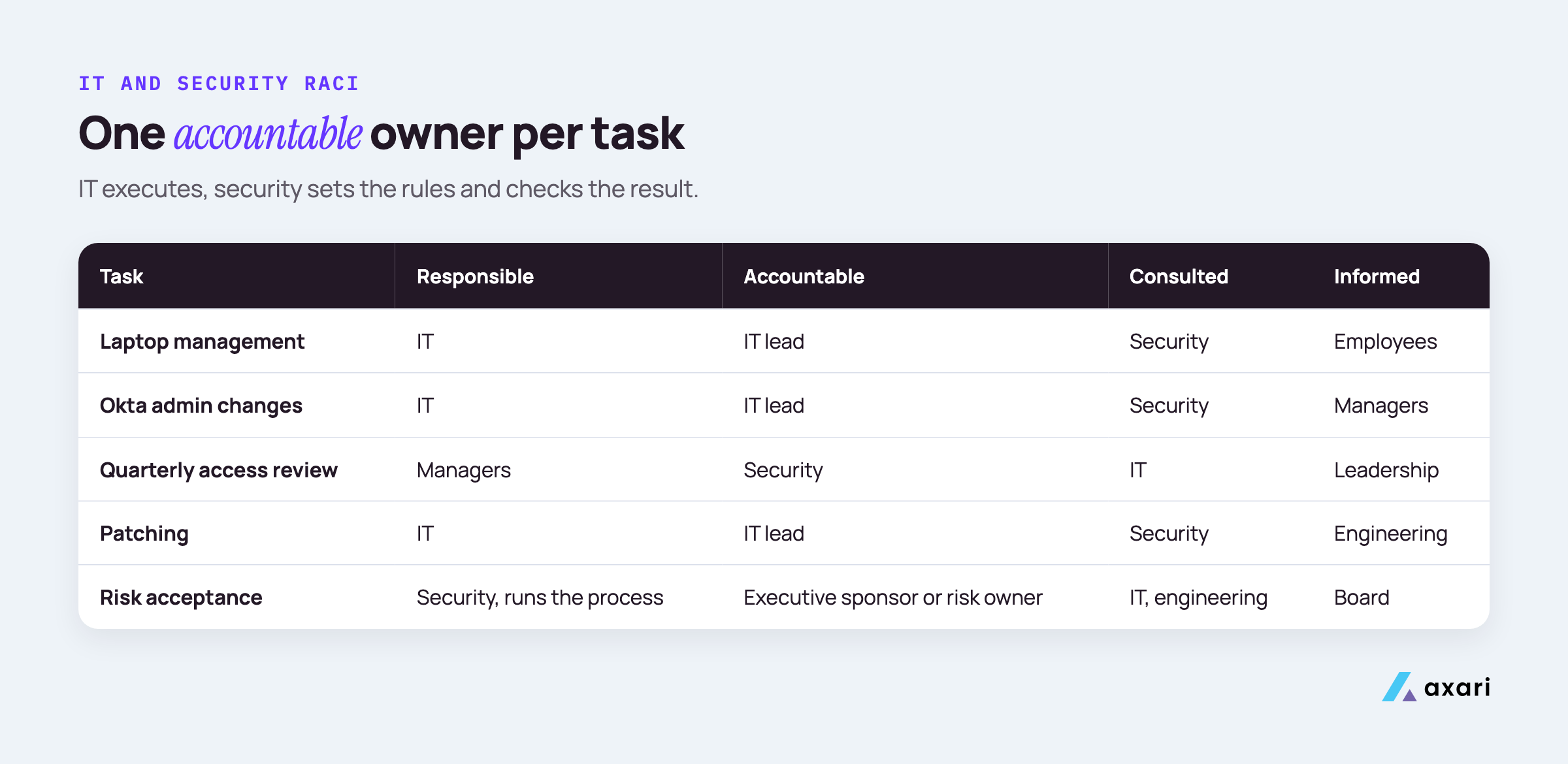
RACI stands for Responsible (does the work), Accountable (owns the outcome and signs off), Consulted (gives input) and Informed (kept up to date). Many people can be responsible. Only one person is accountable.
| Task | Responsible | Accountable | Consulted | Informed |
|---|---|---|---|---|
| Laptop management | IT | IT lead | Security | Employees |
| Okta admin changes | IT | IT lead | Security | Managers |
| Quarterly access review | Managers | Security | IT | Leadership |
| Patching | IT | IT lead | Security | Engineering |
| Risk acceptance | Security (runs the process) | Executive sponsor or named risk owner | IT, engineering | Board |
Agree the table in a meeting instead of by email, so IT helps shape it and owns the result. Then check it against reality after every audit: if the auditor asked IT for evidence that the table says security owns, fix the table.
Should you bring in a fractional CISO, outsource, or hire full time?
Choose by the gap you need filled: a fractional or virtual CISO adds strategy, board reporting and audit leadership a few days a month; an MSSP or MDR provider covers watching and investigating alerts outside your hours; a full-time hire fits once the work needs daily ownership. A common setup is one security lead plus outside help.
| Option | Fills this gap | Fits when |
|---|---|---|
| Fractional CISO | Strategy, board reporting, audit leadership | You need senior judgment a few days a month |
| MSSP or MDR provider | Watching and investigating alerts | Nobody can watch alerts outside working hours |
| Specialist firm | Penetration testing, audit support, incident response retainer | You need depth for a defined piece of work |
| Full-time hire | Daily ownership | The work is steady and the queue keeps growing |
A fractional CISO sets direction but usually won't chase tickets. An MDR provider watches and investigates alerts but won't run your SOC 2 program or carry out the fixes it recommends; security alert triage covers how those fixes get an owner and a check.
Before signing anything, write the gap in one sentence. "We need someone to lead our first SOC 2 audit" points to a fractional CISO or audit support. "We need fixes chased and verified" needs a different kind of help.
Where does an AI Twin fit for a one person security team?
An AI Twin fits the follow-up work between tools: chasing ticket owners, collecting evidence, drafting status updates and re-checking whether a fix landed. It works alongside IT, engineering, a fractional CISO and outside services and doesn't replace any of them. With Axari, every message and change waits for your approval, and evidence is prepared for your upload.
Match the bottleneck to the right helper:
| If the bottleneck is | The better fit is |
|---|---|
| A decision only you can make | You, with protected time |
| Senior judgment or board experience | A fractional CISO |
| Hands on devices or identity | IT |
| Code and infrastructure fixes | Engineering |
| Alert monitoring outside working hours | An MDR or MSSP provider |
| Reminders, evidence gathering, status updates, rechecks | AI agents built for security work |
If you hand any of this to software, set the rules first. What may it draft? What needs your approval before it is sent or changed? What can it never do? Where is the record of what it did? Start with one workflow, such as evidence requests for your next audit, and judge it on real items before adding more.
Software will not make your risk decisions, and alert triage stays with your tools or MDR provider. What it can do is take repetitive follow-up off your plate. For how to evaluate tools in this category, see AI agents for security teams.
When should a startup hire its first security engineer?
Hire the next security person when the work is steady and specialized enough that one person has become a single point of failure: on-call and incident work crowd out planned work, customer or audit commitments start slipping, or engineering waits on your reviews. Make the case with the queue you cannot clear and the risks you have accepted.
A single point of failure means that if you are sick, on holiday or leave, security work stops.
Build the case from facts you already have:
- The queue you cannot clear: open questionnaires, overdue reviews, findings past their SLA.
- The risks you accepted for lack of time, from your written "not doing" notes.
- What the hire would own in the first year, in three or four lines.
On the role itself, a generalist usually helps more than a specialist at this stage: someone who moves between cloud access reviews, vendor reviews and identity work.
Write your hand-offs down before you hire. If you don't, the new person inherits the same confusion you have.
What does a weekly operating plan look like for a security team of one?
Block the week by type of work: one protected morning for risk and roadmap, a fixed slot for questionnaires and access reviews, a short daily triage window, and a Friday check of overdue owners and stale evidence. Guard the planning time first, because reactive work expands to fill whatever the calendar leaves open.
A plan you can adapt:
| When | Work |
|---|---|
| Monday morning | Risk and roadmap: set the week's three priorities |
| Daily, 30 minutes | Triage inbound requests: answer, route or schedule each one |
| Tuesday afternoon | Vendor questionnaires and access reviews, batched |
| Wednesday | Time with engineering: design reviews and open findings |
| Thursday | Policy, audit preparation, time with a fractional CISO if you have one |
| Friday afternoon | Overdue owners, stale evidence, a short note to your manager |
Use the daily window to sort requests: do it now if it takes minutes, route it to its owner, or schedule it into a later block.
The Friday note, a few lines on what moved and what slipped, becomes your monthly report and, later, the raw material for a CISO board report. To run the roadmap as one live map of owners and deadlines, see Security program management without a PMO.
Frequently asked questions
What should the first security hire prioritize in the first 90 days?
Spend the first month listening and mapping systems, data, identity and existing commitments; the second fixing the highest-risk gaps such as MFA, exposed services and untested backups; and the third writing a one-year roadmap leadership signs off. Start a simple monthly report early so progress is visible from the beginning.
What belongs on a security program checklist for a 200 person company?
A 200-person company's checklist usually covers SSO and MFA, device management, patching and vulnerability SLAs, backups tested by restore, logging and alerting, vendor reviews, security awareness, an incident response plan, core policies, and compliance commitments such as SOC 2. Give every item an owner before adding new items.
What is the difference between an MSSP, an MDR provider and a vCISO?
An MSSP manages security tools and monitoring on your behalf, an MDR provider watches and investigates alerts on your endpoints and cloud and can take first containment steps such as isolating a device, while your team owns the fixes, and a vCISO (virtual CISO, another name for a fractional CISO) provides part-time security leadership. They fill different gaps, so a small team might use MDR for monitoring and a vCISO for strategy and audits.
What is a lean security team?
A lean security team is a small security function, often one to three people, that sets strategy and standards while IT, engineering and outside providers carry much of the execution. It works by choosing a few priorities, giving every task one clear owner, and cutting the manual follow-up between tools.
Build the system around you
This week, list your recurring work, sort it into keep, hand off and pause, and send your manager the "not doing" note.
For a team of one, the first outcome to hand over is usually keeping you audit-ready. Axari is the AI workforce for cybersecurity teams. When Vanta or your auditor asks for evidence, an Axari AI Twin gathers it, follows up with the owners and has it ready for you to approve and upload. Nothing is sent or changed without your approval. It adds capacity to the team you have, and you keep the judgment. To see it work on your own audit requests, request a demo.