
You lead security at a company of a few hundred people, and the board wants a security update next month. It may be your first. The numbers you need are spread across Jira, Vanta, your scanners and Okta, and nobody has put them on one page yet.
A good CISO board report template has five parts on three to five slides: a one-line summary, the top risks, program progress, compliance status and the decisions you need. Every number on it names its source and its owner. (CISO means chief information security officer.)
Below you'll find the template, a filled-in example slide, the metrics to show, where each one comes from and how to keep them current all quarter.
What should a CISO board report include?
A CISO board report should include five parts: a one-line summary of the security posture, the top risks and how they moved, program progress against plan, compliance and audit status, and the decisions or funding you need. Keep it to three to five slides, with one clear message per slide and a named source for every number.
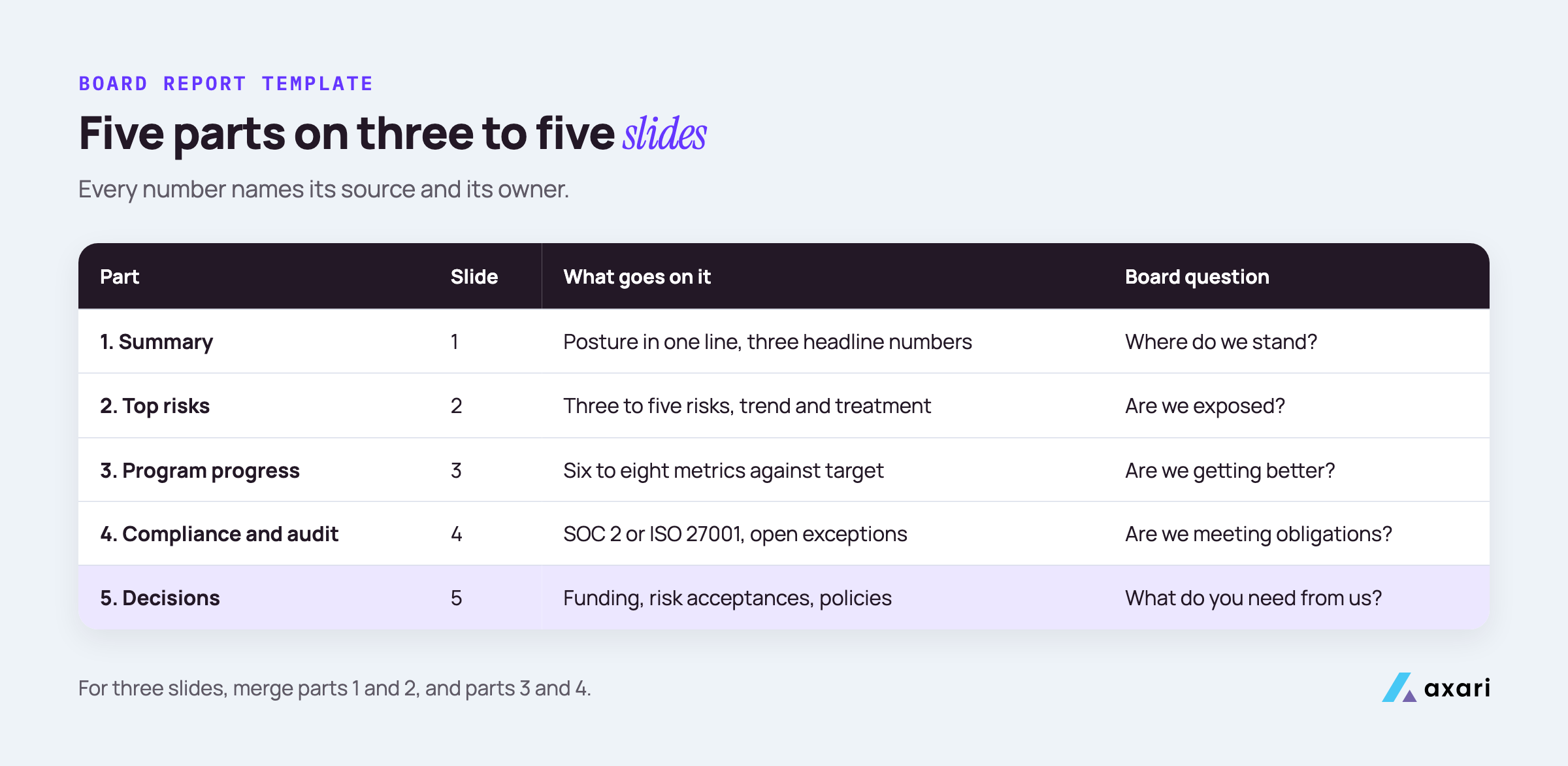
Copy this into your deck and fill in each row.
| Part | Slide | What goes on it | Board question it answers |
|---|---|---|---|
| 1. Summary | 1 | One sentence on posture, three headline numbers, a preview of your ask | Where do we stand? |
| 2. Top risks | 2 | Three to five risks in business terms, each with a trend and a treatment | Are we exposed? |
| 3. Program progress | 3 | Six to eight metrics against last quarter and target; initiatives delivered and slipped | Are we getting better? |
| 4. Compliance and audit | 4 | SOC 2 or ISO 27001 status, customer commitments, open audit exceptions | Are we meeting obligations? |
| 5. Decisions | 5 | Funding and policies you need approved; major risk acceptances leadership has signed, for the board to note | What do you need from us? |
For three slides, merge parts 1 and 2, and parts 3 and 4. Keep decisions on their own slide so the ask never gets lost.
What questions does the board ask the CISO?
Boards commonly ask five things: are we exposed to the incidents we read about, are we meeting our legal and customer obligations, are we getting better than last quarter, how quickly could we recover from a serious incident, and what do you need from us. Build each slide so it answers one of these questions directly, in business terms.
- "Are we exposed to what we read about?" Slide 2. When a breach makes the news, say whether the same weakness exists here.
- "Are we meeting our obligations?" Slide 4. Name the frameworks, contracts and laws that apply, and any open gap.
- "Are we getting better?" Slide 3. The same metrics as last quarter, with the trend.
- "How quickly could we recover?" Slide 2 or 4. Give the date of your last tested backup restore and your last incident response exercise, plus what each test found. A ransomware response plan turns both into readiness tasks with owners.
- "What do you need from us?" Slide 5. A clear decision, with the cost of saying no.
"In business terms" means naming what the business would lose and leaving the technical detail for the appendix. "An attacker could take over an admin account and reach every customer's data" lands better than "privileged accounts lack phishing-resistant MFA". MFA, or multifactor authentication, adds a second check beyond the password.
What security metrics should a CISO present to the board?
Present six to eight metrics that show risk and progress: critical vulnerabilities past their remediation SLA, time to fix critical findings, control test pass rate, open audit exceptions, key initiatives on track versus late, overdue vendor reviews, and MFA coverage. Leave raw alert counts and blocked attacks in the appendix, because they show activity rather than risk.
An SLA, or service level agreement, here means the time to fix you agreed with engineering. Below is a filled-in progress slide for a 400-person SaaS company reporting its third quarter. It lists nine candidates, so pick the six to eight that fit your company. All values are illustrative, not benchmarks.
Slide 3: Program progress, Q3 (illustrative)
| Metric | Q2 | Q3 | Target | Source | Owner |
|---|---|---|---|---|---|
| Critical vulnerabilities past SLA | 9 | 4 | 0 | Wiz, linked Jira tickets | Platform engineering lead |
| Median days to fix critical findings | 21 | 14 | 15 | Wiz detection and rescan dates | Security lead |
| Control test pass rate | 91% | 96% | 98% | Vanta tests | Security lead |
| Open audit exceptions | 3 | 1 | 0 | SOC 2 report, Jira | Security lead |
| Key initiatives on track | 5 of 8 | 6 of 8 | 8 of 8 | Jira epics | Security lead |
| Evidence older than policy allows | 7 | 2 | 0 | Vanta or Drata evidence dates | Security lead |
| Open items with no named owner | 5 | 1 | 0 | Jira, Vanta | Security lead |
| Overdue vendor reviews | 6 | 2 | 0 | Vanta vendor list | Procurement lead |
| MFA coverage, workforce apps | 88% | 97% | 100% | Okta | IT lead |
Under the table, add one line that tells the story: "Exposure fell; the four late fixes sit with one team."
What is the difference between a KPI and a KRI in board reporting?
A KPI measures how well the security program performs, such as remediation time or control pass rate, while a KRI measures how close the business is to its risk appetite, such as critical exposures on internet-facing systems. Boards need both, but KRIs with agreed thresholds should lead the page, since they tell directors when to act.
KPI stands for key performance indicator and KRI for key risk indicator. Risk appetite is how much risk the business has agreed to live with.
| KPI | KRI | |
|---|---|---|
| Asks | Is the team doing the work well? | Are we close to a line we agreed not to cross? |
| Example | Median days to fix critical findings | Critical findings open on internet-facing systems |
| Threshold | A target the team sets | A limit the board or leadership approves |
| Board use | Context for the trend | A trigger for a decision |
A KRI only helps the board once it has a threshold. Say leadership agrees that no critical finding on an internet-facing system stays open past its SLA. Zero past SLA is green. One or two past SLA, each with an owner and a fix date, is amber. More than that, or any without an owner, is red, and red goes on slide 2 with a name and a date.
Agree the thresholds in writing at the start of the year. Then each quarter the board checks every number against a line it has already approved.
How do you present cybersecurity risk to the board?
Present cybersecurity risk as business risk: name the process or revenue at stake, the impact, the trend since last quarter and the decision you want. NACD's Director's Handbook on Cyber-Risk Oversight treats cybersecurity as a strategic, enterprise-wide risk, not only an IT risk, and SEC rules require public companies to describe board oversight of cyber risk in their annual 10-K.
The Director's Handbook on Cyber-Risk Oversight, published by the National Association of Corporate Directors (NACD) with the Internet Security Alliance, is written for directors. Its Tool K lists board-level metrics and Tool L shows example board reporting.
For public companies, the SEC's cybersecurity disclosure rules added Regulation S-K Item 106. Companies must describe the board's oversight of risks from cybersecurity threats in their annual report on Form 10-K, under Item 1C. The final rule has the full text. Private companies are not covered, but investors and enterprise customers often ask similar questions.
A simple way to write each risk on slide 2:
- What could happen: an attacker takes over an admin account in production.
- What it would cost: customer data exposed across every tenant, and renewals at risk.
- Trend: lower than last quarter, because admin MFA is now enforced.
- What remains: two service accounts still use static keys.
- Decision: none needed, or approve the budget on slide 5.
Where does each board metric come from in Jira, Vanta and your scanners?
Each metric should come from the system of record: vulnerability age and SLA status from scanners such as Wiz, Snyk or Qualys and their linked Jira or ServiceNow tickets, control pass rates and evidence freshness from Vanta or Drata, initiative status from Jira epics, and vendor review dates from your GRC platform. Write the source and owner beside every number.
GRC stands for governance, risk and compliance. A GRC platform such as Vanta or Drata tests controls and stores audit evidence. A system of record is the one tool whose number you trust when two tools disagree.
For each metric, keep a short card:
- Name and definition. "Critical vulnerabilities past SLA: P1 and P2 findings (known exploited, or likely to be, on exposed systems) open longer than the agreed days, counted from detection and closed only on a clean rescan."
- System of record. Wiz for the finding, Jira for the fix.
- How to pull it. A saved filter, written down. Fixes live in each engineering team's own project, so filter on a shared label instead of a single security project. An illustrative Jira query:
labels = security AND priority in (Highest, High) AND statusCategory != Done AND duedate < now(). - Owner. The person who answers for the number, who is often not the person who pulls it.
- Last refreshed. A date, so a stale number is obvious.
Pull every number from the source tool, never from last quarter's slide. When the scanner and the ticket disagree, trust the scanner: a ticket can be closed while the finding is still open.
What is the difference between a board report, an executive dashboard and a QBR?
A board report is quarterly, short and focused on risk and decisions; an executive dashboard is live or monthly and focused on operations; a quarterly business review sits between them, checking the quarter's plan with leadership. Use the same underlying metrics in all three and change only the depth: trends for the board, owners and exceptions for executives.
| Board report | Executive dashboard | QBR | |
|---|---|---|---|
| Audience | Board or its audit or risk committee | CEO, CTO, engineering and IT leads | Leadership team |
| Cadence | Quarterly | Live or monthly | Quarterly |
| Depth | Trends, top risks, decisions | Every metric, by team, with owners | Plan versus delivery, next quarter's plan |
| Ends with | A decision or approval | A list of exceptions to chase | Agreed priorities and resources |
QBR stands for quarterly business review. In practice, the QBR often comes a few weeks before the board meeting and works as a rehearsal: leadership challenges the numbers, agrees what goes red, and settles the ask.
If the board sees a 96% control pass rate and the dashboard shows 93%, someone will notice. Take the board numbers from the dashboard on a fixed date, so all three views agree.
How often should the CISO report to the board?
Quarterly is the common rhythm, usually to the full board or its audit or risk committee, with a deeper annual session on strategy and the risk register and a prompt update after any serious incident. For most private companies the cadence is set by the board and its committee charters, so agree it with your chair early.
A committee charter sets out what a board committee oversees, so it tells you which committee you report to.
A workable year looks like this:
| When | What |
|---|---|
| Each quarter | The board report from this template |
| Once a year | Strategy, risk register review, risk appetite and thresholds |
| After a serious incident | What happened, impact, what changed |
| Between meetings | A short written note if a KRI turns red |
The foreword to NACD's 2026 handbook, written by CISA's acting director, says cybersecurity "must be a standing item on the agenda every quarter."
At your first meeting, agree three things with the chair: how often you report, to which committee, and what counts as serious enough for an update between meetings.
How do you show security program progress to the board quarter over quarter?
Show the same metrics every quarter, each against last quarter and its target, plus a short list of initiatives committed, delivered and slipped. Keep definitions fixed so the trend is honest, note any change in how a number is measured, and pair every red item with an owner and a new date, so directors see accountability as well as status.
The initiatives list is short. A hypothetical example:
- Committed this quarter: 4 initiatives.
- Delivered: 3, including SSO for all finance apps and quarterly access reviews in Vanta.
- Slipped: 1. Logging for the data warehouse is blocked on a vendor contract; the data platform lead owns it, with a new date of mid-November.
If you already keep a program map with owners, deadlines and evidence, as described in Security program management without a PMO, this list is a filter on that map and needs no extra work.
To keep the trend believable:
- Freeze definitions. Widen "critical vulnerabilities" to include internal systems and the number will jump. If you change a definition, add a footnote and show the old measure alongside for one more quarter.
- Keep a history tab. Store each quarter's numbers once, on the day you pull them. Next quarter's "last quarter" column comes from there, never from memory.
How does a lean security team build the board report without a week of spreadsheets?
Keep the numbers current all quarter instead of rebuilding them in the final week: fix each metric's source, owner and definition, refresh them monthly, and chase overdue owners as you go. A spreadsheet works for a small team with few sources; a reporting tool or an AI Twin that gathers figures and evidence for your approval helps as sources multiply.
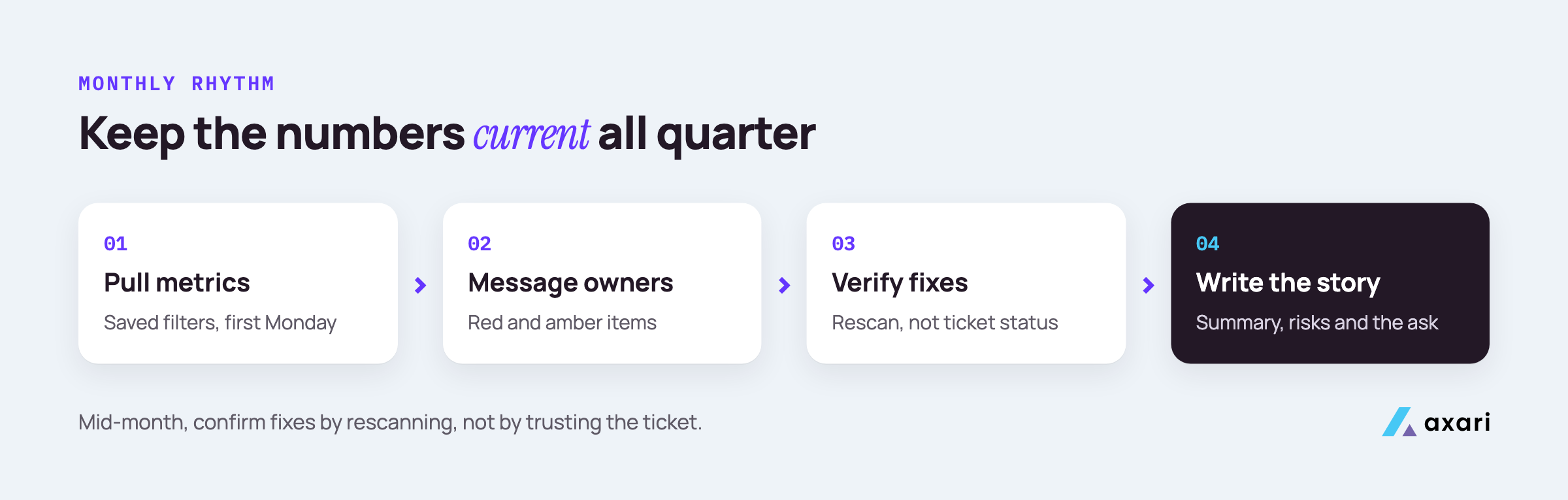
A monthly rhythm that fits a small team:
- First Monday of the month: pull every metric from its saved filter into the history tab. Note anything that moved more than expected.
- Same week: for each red or amber number, message the owner with the item, the agreed date and the smallest next step.
- Mid-month: confirm the fixes closed by re-running the scanner or the Vanta test. Ticket status alone doesn't count.
- Board month: pull the numbers one last time and put your effort into the summary line, the risks and the ask.
If you are the whole security team, the chasing in step 2 is where the time goes. Security team of one covers how to hand off that kind of coordination work. Whether a person or software carries it, each message should be drafted for your approval, and the decisions about what goes on the slide stay with you.
Frequently asked questions
How many metrics should you show at your first board meeting?
Show six to eight metrics across three to five slides, and keep everything else in an appendix. A first meeting is mostly about setting the baseline: where risk stands today, what you plan to change this year, and which numbers you will report every quarter so the board can track progress.
What does a board security report look like for a startup with no CISO?
Whoever owns security, often the CTO, head of engineering or a fractional CISO, presents one page: the top risks, compliance status such as SOC 2, security asks from customers, any incidents, and next quarter's plan. Keep the same page every quarter so the board sees the trend even before a security leader is hired.
Should you use a board reporting tool or a spreadsheet?
A spreadsheet is fine while you have a handful of metrics and one or two sources, as long as each cell names its source. Move to a reporting tool when pulling numbers from Jira, Vanta and scanners by hand takes real time each quarter, or when several people need the same live view.
Start with the source column
Before you design a single slide, list the six to eight metrics you plan to show in a spreadsheet, each with its definition, system of record, filter and owner. Pull the numbers once this month, and you have the draft of your first board report.
The harder part is keeping those numbers true between meetings, which means keeping your critical security initiatives on track. Security tools find the work. Axari makes sure it gets done. An Axari AI Twin chases owners in Slack or Microsoft Teams, re-checks fixes and keeps evidence current, so the board page is ready for your review. You keep the judgment, and nothing is sent or changed without your approval. To see how it would work with your own tools, request a demo.