
You run security at a company of a few hundred people. The roadmap lives in Jira, the risk register sits in a spreadsheet, Vanta or Drata tracks the controls, and the real status is in your head. Nobody on the team is a program manager.
Security program management without a PMO comes down to one live map of risks, initiatives, owners, deadlines and evidence, reviewed on a fixed weekly rhythm. A small team can skip the separate office and still run the habits that office would bring.
Each section answers one question: what program management means for a small team, how to track initiatives and risks, how to spot slips early, how to work with engineering and how the same map becomes audit evidence and board reporting.
What is security program management?
Security program management is turning security goals into initiatives with owners, deadlines and evidence, then tracking them until they are done. A security program management office, or PMO, does this full time in large companies: it runs the roadmap, status reporting, dependencies and governance across security, engineering and IT, so the security team can focus on the work itself.
A project has an end date: roll out single sign-on to every app by June. A program is the set of projects that together reduce your risk, plus the routine that keeps them moving. Program management is that routine.
At any point, your program should be able to answer four questions:
- What are we working on, and why? Each initiative traces back to a risk or a commitment, such as a SOC 2 audit or a clause in a customer contract.
- Who owns each piece? One named person, not a team or a Slack channel.
- When is it due, and is it on track?
- How will we prove it is done? A merged pull request, a passing test, a signed policy.
The NIST Cybersecurity Framework 2.0 added a Govern function that covers risk strategy, policy, oversight, and cybersecurity roles, responsibilities and authorities. A PMO is one way to staff that work. A small team can cover the same ground with a short list, a weekly meeting and clear owners.
Do you need a security PMO or program manager?
Most security teams of 1 to 15 people need the habits of a PMO rather than a separate office. Consider a program manager when initiatives span several business units, regulators or customers expect formal status, or a deputy CISO spends most of the week on coordination. Until then, the security lead owns the program rhythm.
What a PMO does, and the lean version a small team can run instead:
| What a PMO does | The lean version |
|---|---|
| Maintains the roadmap | One program map, usually in Jira, owned by the security lead |
| Produces status reports | A 30-minute weekly review and a short written note |
| Tracks dependencies | A blocker noted on the Jira epic, with a named owner |
| Runs governance and escalation | Agreed deadlines; a direct reminder first, the owner's manager only for repeated misses or SLA breaches |
| Builds board and audit packs | Pulled from the evidence attached to each closed item |
If you do add a program manager later, hand them the map you already run rather than a blank page. If you are the only security person, Security team of one covers what to keep and what to hand off.
How do you track security initiatives and roadmap progress?
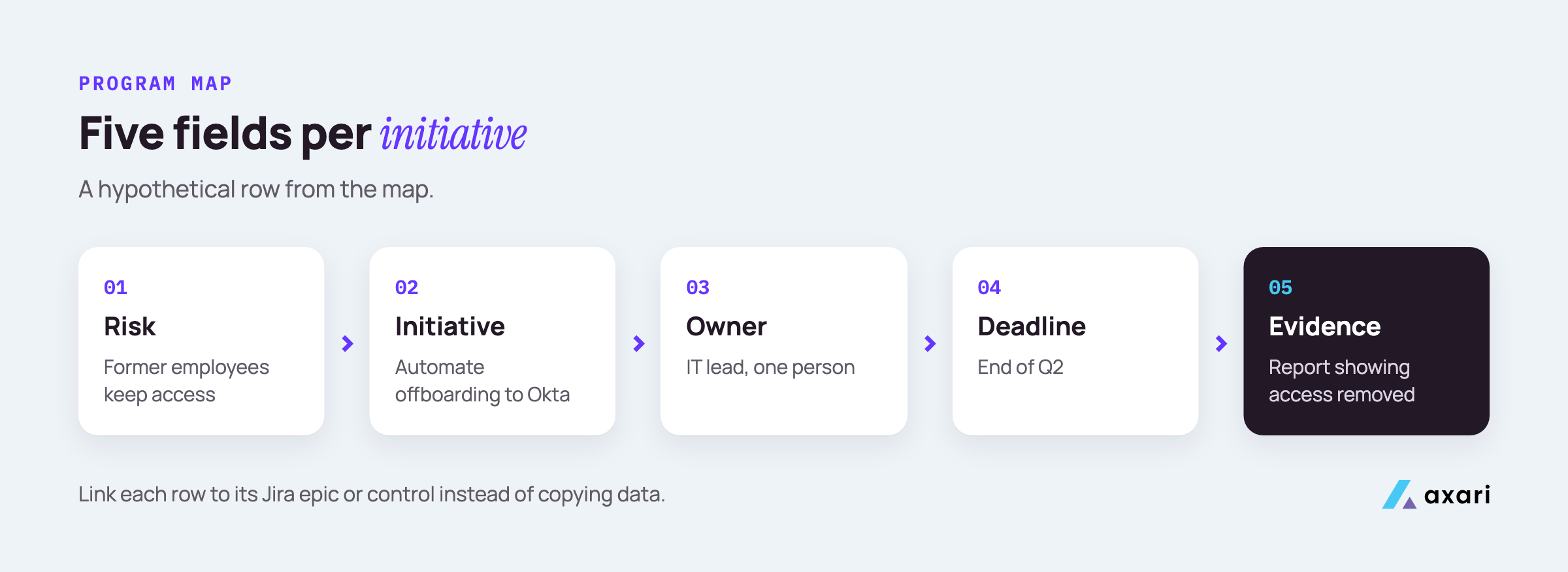
Track every initiative in one live program map with five fields: the risk it reduces, the initiative, one named owner, a deadline, and the evidence that proves it is done. Keep the map where work already happens, usually Jira, and link to Vanta, Drata or your scanners instead of copying their data into a separate spreadsheet.
Say you have a few dozen initiatives spread across Jira, Vanta and two spreadsheets. Getting them into one map is mostly sorting:
- Gather. Pull every initiative from Jira epics, your GRC platform, spreadsheets and your own notes into one list. Expect duplicates.
- Merge and prune. Combine duplicates. Anything with no risk or commitment behind it goes to a "not now" list.
- Name one owner. If nobody will accept an item, raise it with leadership. Better tracking won't solve it.
- Link, don't copy. Each row points to its Jira epic and, where relevant, its Vanta or Drata control. The map stays small because the detail lives in the source tools.
A hypothetical row looks like this:
| Risk | Initiative | Owner | Deadline | Evidence |
|---|---|---|---|---|
| Former employees keep access to customer data | Automate offboarding from the HR system to Okta | IT lead | End of Q2 | Offboarding report showing access removed |
Five columns are enough to start, plus the status Jira already tracks. Note blockers on the Jira epic instead of adding columns. Extra fields go stale faster, and people stop trusting a stale map.
How do you keep a security risk register with owners and deadlines on a small team?
Keep the risk register short and linked: each risk gets a named owner, a treatment decision, a review date and the initiative or ticket that addresses it. A GRC platform's register, a Jira project or a shared spreadsheet all work for a small team, as long as every row points to live work and someone reviews overdue rows monthly.
A risk register is a list of the things that could hurt the business, with a decision about each one. The decision, called the treatment, is usually one of four:
- Reduce: do work that lowers the risk. This is where initiatives come from.
- Accept: a named risk owner or executive sponsor agrees to live with it, in writing, with a reason, compensating controls and an expiry date. Security runs the process; new requests go to the monthly leadership review, and open exceptions are reviewed quarterly.
- Transfer: move part of it elsewhere, for example through insurance or a contract.
- Avoid: stop the activity that creates the risk.
Keep the register short. Write each risk in words a manager outside security would understand, such as "a former employee keeps access to customer data", instead of a control code.
Every "reduce" decision should point to a row on the map, and every accepted risk needs an expiry date.
How do you spot security initiatives slipping before the audit?
Watch for drift signals every week: a ticket with no update for two weeks, an owner who changed teams, a deadline moved twice, evidence older than your policy allows, or a Vanta or Drata test that has started failing. Each signal is cheap to fix when it is new, and reviewing them weekly surfaces slips long before audit fieldwork.
Each signal has a cheap first move:
| Signal | First move |
|---|---|
| No update for two weeks | Ask the owner for one sentence of status and a next step |
| Owner changed teams | Confirm the new owner with their manager the same week |
| Deadline moved twice | Ask what is blocking it; the blocker is the real item |
| Evidence older than policy allows | Request fresh evidence now, not during fieldwork |
| A GRC test started failing | Open or update the ticket and name who fixes it |
"Drift" means work or controls quietly moving away from the plan: a ticket that goes quiet, an owner who leaves, or a control that once worked and stopped, such as logging turned off on a new storage bucket.
Audit fieldwork is the period when the auditor tests your controls and asks for evidence. Slips found then are expensive because everyone is rushing. A slip caught in a Monday review is usually a five-minute conversation.
How do you keep security projects on track across engineering teams?
Put security work into each engineering team's own backlog, with a priority they agreed to and a date that fits their planning cycle. Agree remediation SLAs up front, show each team its own open items, and send a direct reminder first. Go to their manager only for repeated misses or SLA breaches, so security requests arrive as planned work instead of interruptions.
An SLA, or service level agreement, here means an agreed time to fix: for example, P1 findings (known exploited, on a reachable asset) fixed this sprint. Agree the numbers once with engineering leadership, write them down, and stop negotiating them ticket by ticket. The clock starts at detection, and a fix counts as within SLA only once it is verified.
In practice:
- Join their planning. Bring security items to sprint or quarterly planning instead of dropping them in mid-sprint.
- Make tickets complete. Each one names the service, the risk in one sentence, a suggested fix and the agreed date.
- Show each team its own list. A Jira filter per team works better than one big security board nobody opens.
- Escalate repeated misses. If one team keeps missing dates, talk to their manager about capacity instead of sending a stream of angry tickets.
How do you chase owners for security remediation without being annoying?
Chase with context rather than volume: one reminder that names the item, why it matters, the agreed date and the smallest next step, sent where the owner already works. Keep a predictable schedule, thank people when items close, and escalate only repeated misses or SLA breaches. An AI Twin can draft and send these follow-ups once you approve.
A good reminder is short and specific. A hypothetical example in Slack:
Hi Priya, the offboarding automation item (PROJ-412) is due Friday. It closes the former-employee access risk we flagged in Q1. Smallest next step: list the apps that still need manual removal. Happy to pair on it for 15 minutes.
A predictable rhythm, so nobody feels ambushed:
- A heads-up a few days before the due date.
- A reminder on the due date with the smallest next step.
- A check-in a week later asking what is blocking it.
- Only if the item breaches its SLA, or the same team keeps missing dates, a note to their manager, framed as a capacity question.
Send reminders in Slack, Microsoft Teams or a Jira comment, not a separate email thread. When an item closes, say thanks in the same place.
What does a weekly security program operating rhythm look like?
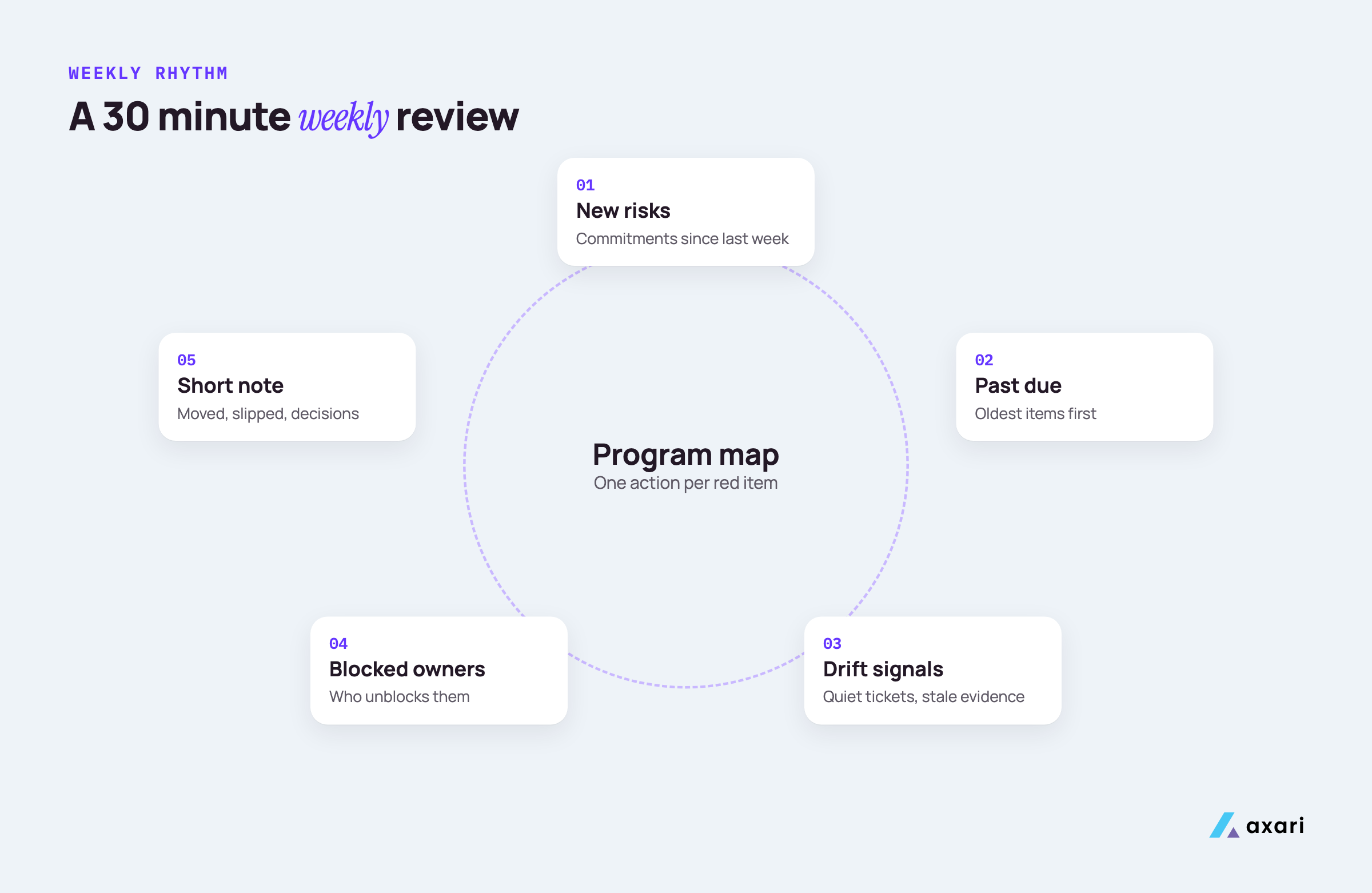
Run a 30-minute weekly review of the program map covering new risks, items past due, drift signals and blocked owners, with one action per red item. Add a monthly review with engineering and IT leads, a quarterly roadmap and board update, and an annual reset of priorities against the risk register, so each meeting has a clear job.
| Cadence | Who | Job |
|---|---|---|
| Weekly, 30 minutes | Security lead, plus anyone owning a red item | Past due, drift signals, blockers, one action each |
| Monthly, 45 minutes | Engineering and IT leads | Team-level open items, upcoming deadlines, capacity |
| Monthly | Leadership | Decide new risk acceptance requests |
| Quarterly | Leadership, then the board | Roadmap progress, review of open exceptions, next quarter's plan |
| Annually | Security lead and leadership | Reset priorities against the risk register |
A simple weekly agenda:
- New risks or commitments since last week.
- Items past due, oldest first.
- Drift signals from the list above.
- Blocked owners and who unblocks them.
Write the outcome as a short note: what moved, what slipped, what needs a decision. Saved each week, those notes become the raw material for the monthly and quarterly reviews, and you stop building status reports from scratch. A meeting with no job on this table can go.
Should you use a GRC platform, Jira or a spreadsheet for security initiatives?
Use each tool for what it does best: a GRC platform such as Vanta or Drata for controls, tests and evidence, Jira or ServiceNow for initiatives and remediation, and a spreadsheet only as a temporary index. Vanta's agent can now create the Jira ticket, assign it to the right owner and link it back; what remains is follow-through.
GRC stands for governance, risk and compliance. A GRC platform connects to your cloud, identity and code tools, tests controls continuously and stores audit evidence.
| Tool | Best for | Watch out for |
|---|---|---|
| Vanta or Drata | Controls, automated tests, evidence, auditor access | Initiatives that don't map to a control |
| Jira or ServiceNow | Initiatives, remediation tickets, owners, dates | Security work buried in team backlogs with no overview |
| Spreadsheet | A temporary index while you consolidate | Becoming the system of record and going stale |
In a product update dated 28 August 2026, Vanta announced agentic ticketing, where Vanta Agent can create the Jira ticket, assign it to the right owner and link it back, across documents, tests and risk scenarios, and it can also create a Jira issue automatically when a test starts failing. What remains is everything after: getting the owner to act, confirming the fix and keeping the evidence current.
How do you turn the program map into audit evidence and board reporting?
Make the evidence field do double duty: when an initiative closes, attach the proof, such as a merged pull request, a passing scan or a signed policy, and link it to its control. The same map then feeds the auditor's request list and the board's progress page. An AI Twin can prepare that evidence for your approval and upload.
Good evidence is specific, dated and easy to check:
| Initiative | Evidence that closes it |
|---|---|
| Automate offboarding | Identity provider report showing leavers' access removed, with dates |
| Patch an internet-facing service | Scanner result showing the finding resolved |
| Encrypt backups | Cloud configuration screenshot or export |
| Annual policy review | Signed policy with approver and date |
A SOC 2 Type 2 report, which an independent auditor issues under the AICPA's SOC 2 framework, tests whether controls operated effectively over a period, while a Type 1 report checks that they are suitably designed at one point in time. Because a Type 2 auditor samples across the whole period, collecting evidence when the work closes saves you from reconstructing it months later.
For the board, group the same map differently. One page is usually enough: initiatives completed this quarter, items at risk with the reason, risks leadership has accepted, and next quarter's plan. Every line can point back to evidence, so when a director asks "how do we know?", the answer is already attached. The CISO board report template shows that page slide by slide.
Frequently asked questions
What is security control drift detection?
Security control drift detection means noticing when a control that once passed stops working, for example MFA missing on a new admin account, logging off on a new storage bucket, or a policy past its review date. GRC and cloud security tools test many controls continuously; the program work is routing each failure to an owner and confirming the fix.
What does a deputy CISO do in program management?
In many teams the deputy CISO runs the program day to day: keeping the roadmap and risk register current, chairing the weekly review, chasing owners across engineering and IT, and preparing the quarterly board material. That frees the CISO for strategy, leadership relationships and the decisions that need executive weight.
Is there a security roadmap template for a small team?
Yes. A useful security roadmap template lists each initiative with the risk it reduces, its owner, quarter, status and the evidence of completion, grouped by theme such as identity, vulnerability management and compliance. Keep it to one page per year and link each line to the Jira epic or GRC control behind it.
Start with one list this week
Pull your initiatives into one map this week, give each row one owner and one piece of evidence, and hold the first 30-minute review on Monday.
The part that wears people down is the follow-up between reviews. Security tools find the work. Axari makes sure it gets done. An Axari AI Twin keeps your critical security initiatives on track: it keeps the map current, follows up with each owner, prepares evidence for your approval and upload, and tells you what slipped. You keep the judgment, and nothing is sent or changed without your approval. To see it on your own program, request a demo.
"I wanted a teammate that actually moved work forward. Not just a copilot." Jake Bernardes, CISO, Gambit