
A deal is close. Sales pings you with a spreadsheet of security questions due Friday. You have answered most of them before, but the old answers are buried in email threads, and you are the only person who knows which ones are still true.
The fastest way to answer security questionnaires is to stop writing each one from scratch. Draft from a library of approved answers, attach current evidence, and send only the questions that need judgment to a named owner.
Read on for why security becomes the bottleneck, how to build and maintain an answer library, which answers still need a human, where ChatGPT and Claude help and who should own the process.
What is a security questionnaire?
A security questionnaire is a set of questions a prospective customer sends to check how you protect their data before they sign. It covers access control, encryption, incident response, vendor management and your policies. Some buyers send a standard form such as the SIG or the CAIQ; many send their own spreadsheet or portal.
The two standard forms you are most likely to see both come from industry groups:
- The SIG (Standardized Information Gathering questionnaire) is a licensed questionnaire from Shared Assessments, updated every year. SIG Lite is the shorter version for lower-risk reviews; SIG Core is for suppliers that hold highly sensitive or regulated data.
- The CAIQ (Consensus Assessments Initiative Questionnaire) comes from the Cloud Security Alliance. It is a set of yes or no questions mapped to the CSA's Cloud Controls Matrix, a list of security controls for cloud services, and it is what providers submit to the CSA's STAR Registry.
Custom questionnaires are the buyer's own list, sent as an Excel file, a Word document or a login to a vendor risk portal. Your company sends the same forms to its own suppliers; our guide to vendor security assessment covers the reviewer's side of the exchange.
The wording changes from buyer to buyer, but the topics repeat. Almost every form asks whether you enforce multifactor authentication (a second login step, such as a code from an app), whether you encrypt data, how you handle incidents and whether you have a recent audit report. Because the topics repeat, most answers can be reused.
Why does the security team become the bottleneck on sales deals?
The security team becomes the bottleneck because every questionnaire lands on the few people who know the real answers, usually the GRC lead or the only security engineer. Sales needs a reply this week, questions arrive in different formats, and each one pulls that person away from remediation and audit work, so deals wait in a queue.
GRC stands for governance, risk and compliance: the people who own policies, audits and frameworks such as SOC 2. On a small team, that is often the same person who also patches servers and reviews access.
A typical week on a small team:
- A sales rep forwards a questionnaire in Slack or email, often with little context about the buyer.
- It sits in the security lead's inbox next to other requests, with no shared view of what is waiting.
- The lead opens last quarter's answers, finds several slightly different versions of the same reply, and has to decide which one is current.
- Halfway through, a vulnerability or an audit request pulls them away.
- Sales asks for a status update, which interrupts the work again.
None of these steps is hard on its own. The trouble is that one person routes every question, deal and follow-up. The fix is to make most answers available without that person and put the rest in one visible queue.
How do you answer security questionnaires faster?
Answer security questionnaires faster by never starting from a blank page. Draft every reply from an approved answer library, attach current evidence such as your SOC 2 report or policies, and send only the questions that need judgment to a named owner. Track each request in one queue so sales can see status without chasing the security team.
A SOC 2 report is an independent auditor's report on your controls, measured against the Trust Services Criteria from the AICPA. A Type 1 report covers whether controls are suitably designed at a point in time; a Type 2 report covers whether they operated effectively over a period. State which type you hold, because some buyers accept the report in place of many individual answers.
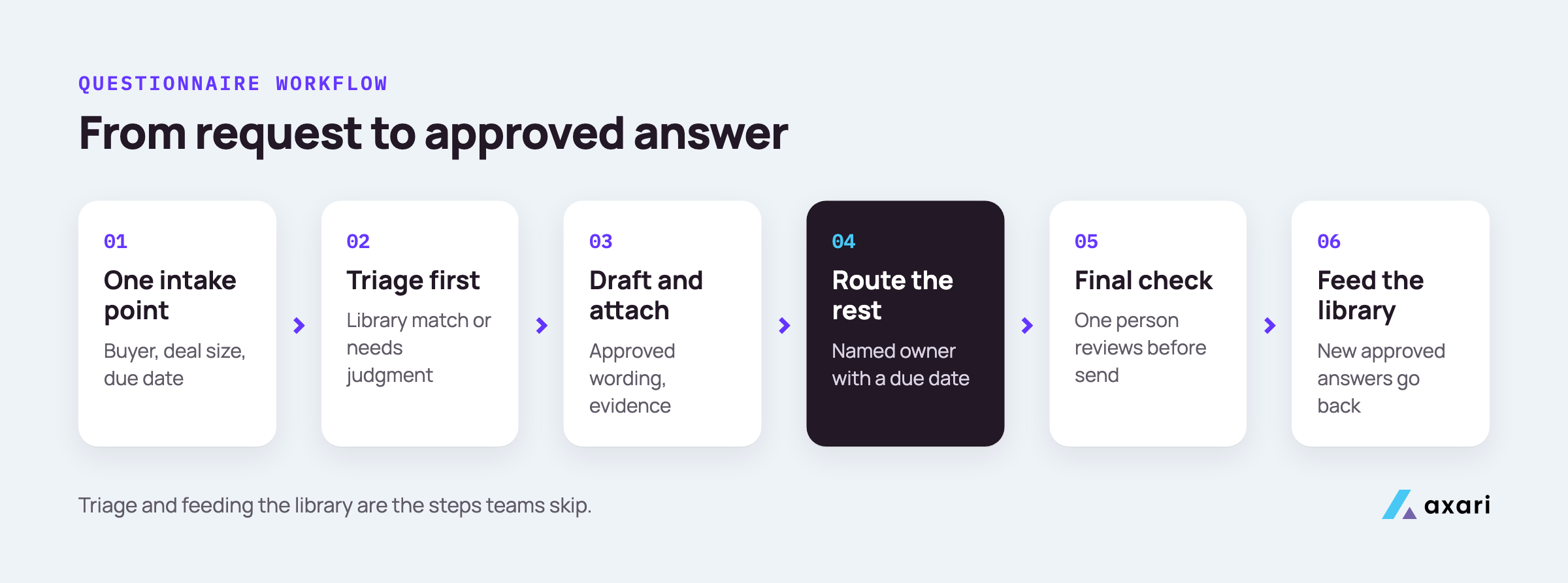
A workflow small teams can run:
- One intake point. Every questionnaire goes into one place, such as a Jira project or a dedicated Slack channel, with the buyer, deal size and due date.
- Triage first. Before answering anything, mark each question as "library match" or "needs judgment". Most will be library matches.
- Draft and attach evidence. Fill library matches with approved wording, adjusted only to fit the buyer's phrasing. Add your SOC 2 report (usually under NDA), relevant policies and a penetration test summary if you share one.
- Route the rest. Send judgment questions to a named owner with a due date, not to a group channel.
- Final check and send. One person reviews the full response before it leaves.
- Feed the library. Every newly approved answer goes back into the library, so you never write it twice.
How do you build a security questionnaire answer library?
Build the answer library from the questions buyers send you instead of a generic list. Give each answer one owner, the source document it quotes and a review date, and keep a short and a long version. Sales can then reuse approved answers without guessing, and you stop rewriting the same replies every week.
Start by collecting your last five to ten completed questionnaires. Group questions that ask the same thing in different words, then write one approved answer per group. A spreadsheet or a page in Confluence or Notion is enough to begin.
| Field | Why it matters |
|---|---|
| Question (and common variants) | Helps people find the answer when the wording changes |
| Short answer | Yes, no or one sentence, for forms with tight boxes |
| Long answer | Two to four sentences with detail, for open text fields |
| Owner | The person who confirms the answer is still true |
| Source document | The policy or control the answer quotes |
| Last reviewed | Shows at a glance whether the answer is stale |
| Evidence | The file to attach, such as a policy or audit report |
Write the plain yes or no first, then the detail. If the honest answer is "partly", say so and explain what is in place. Buyers trust a clear partial answer more than a vague full one, and it protects you later in contract review.
How do you keep security questionnaire answers up to date?
Keep answers up to date by tying each one to the policy or control it describes and reviewing it when that source changes, not only once a year. Set review dates, flag any answer older than your last policy update, and pull current policy language into drafts instead of copying last year's reply from an old spreadsheet.
Answers usually go stale after one of these changes:
- A policy changes. You update your incident response plan or data retention policy.
- A tool changes. You move single sign-on to Okta, switch cloud regions in AWS, or add a new scanner such as Wiz or Snyk.
- An audit finishes. A new SOC 2 report replaces the old one, or an auditor notes an exception.
- A vendor changes. You add or drop a subprocessor that handles customer data.
When one of these happens, search the library for every answer that mentions it and send those answers to their owner for a quick check. If you track policies and controls in Vanta or Drata, use the policy version and control status there as the source, and note in the library which control each answer depends on.
Once a quarter, sort the library by "last reviewed" and clear anything older than your latest policy update. That catches the most common mistake, which is confidently sending an answer that was true last year.
Which security questionnaire answers need human review?
Any answer that commits you to something new needs human review: contract terms, custom SLAs, data residency, breach notification timelines, roadmap promises and anything that differs from your written policies. A control that recently changed, or a question you have never answered before, also needs a person. Routine answers already approved in the library usually do not.
An SLA (service level agreement) is a contractual promise, such as uptime or response time. Once it is in a questionnaire, it can end up in the contract.
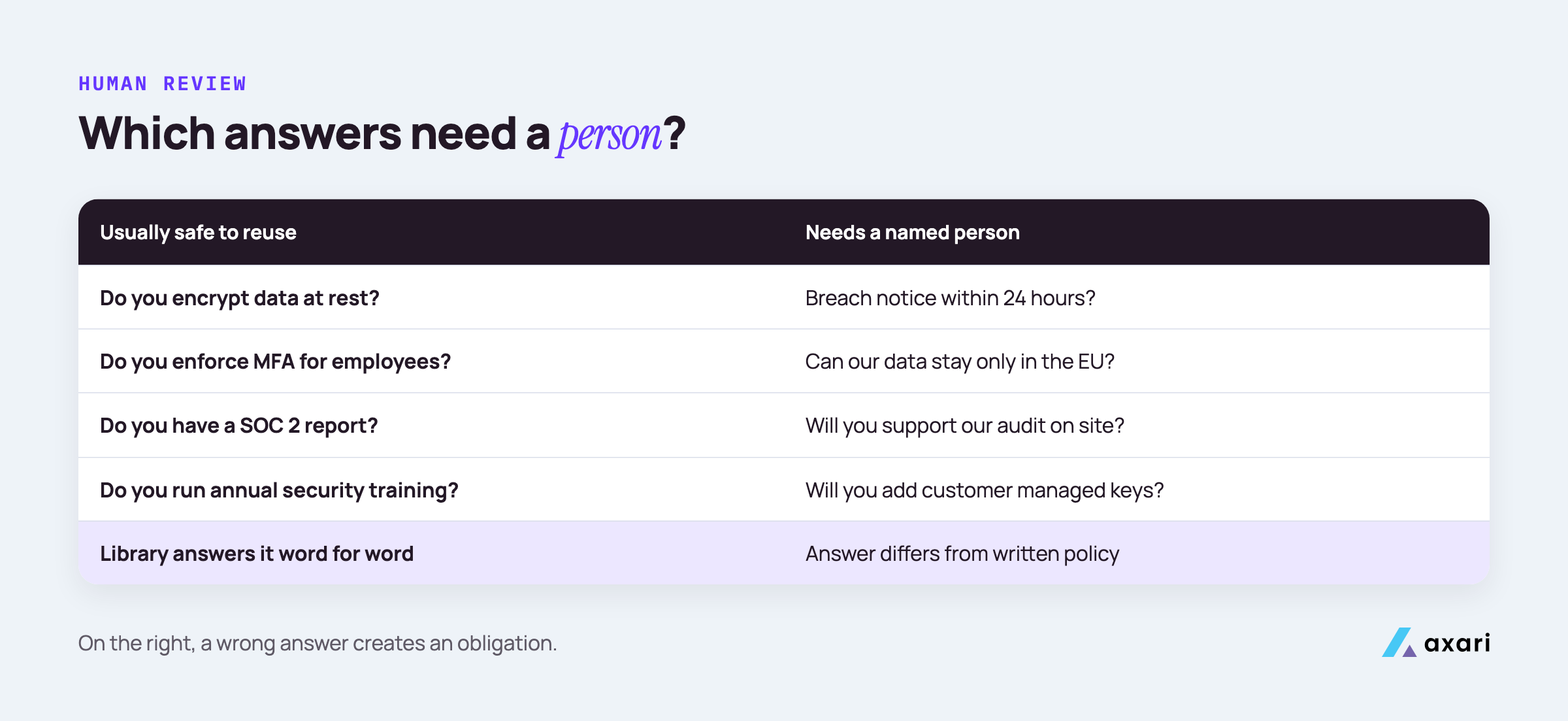
A quick way to sort questions:
| Usually safe to reuse | Needs a named person |
|---|---|
| "Do you encrypt data at rest?" with an approved answer | "Will you notify us of a breach within 24 hours?" |
| "Do you enforce MFA for employees?" | "Can you keep our data only in the EU?" |
| "Do you have a SOC 2 report?" | "Will you support our audit on site?" |
| "Do you run annual security training?" | "Do you plan to add customer-managed keys?" |
| Questions the library answers word for word | Any answer that differs from your written policy |
Everything in the right column shares one risk: a wrong answer can become a contractual obligation. Route those to the person who can make the commitment, which may be legal or engineering rather than security.
Can you use ChatGPT to answer security questionnaires?
You can use ChatGPT to draft security questionnaire answers, but not to decide them. A general assistant does not know your current controls unless you give it your policies, and it will write a confident answer even when the true answer is no. Check your plan's data settings first, draft from approved material, then have the owner verify every claim.
ChatGPT and Claude can rewrite an approved answer to fit a buyer's phrasing, shorten it for a small text box, or spot which library answer matches an oddly worded question. A chat won't carry the work for you, though. You still paste in policies, check drafts, chase owners and track what was sent. That follow-through is the difference between a chat and an AI agent for security teams.
The danger lies in where the facts come from. A safe pattern:
- Check data settings. OpenAI says it does not train on data from its business products by default, and Anthropic's consumer terms update lets Free, Pro and Max users choose whether their chats are used for training, while commercial plans fall under separate terms. Confirm which plan you are on before pasting policies in, and put any AI vendor through the same questions to ask AI security vendors.
- Give it approved material only. Paste the library answer and the relevant policy, not a blank question.
- Ask it to adapt only. Tell it to mark any question the material does not cover as "needs owner" instead of inventing an answer.
- Verify every claim. The answer owner reads the draft before it goes into the response.
Who should own security questionnaires: sales engineering or security?
Security or GRC should own the content of the answers, and sales engineering should own the process with the customer. Sales engineers can send approved answers directly and handle formatting and deadlines. Anything new, changed or contractual goes back to the security owner. Write that split down so nobody has to guess who is accountable for an answer.
A sales engineer is the technical person on the sales team who handles product and integration questions during a deal.
A short split you can agree on in one meeting:
| Task | Owner |
|---|---|
| Receive the questionnaire and log it in the queue | Sales engineering |
| Fill library matches and format the response | Sales engineering |
| Answer new, changed or contractual questions | Security or GRC |
| Approve additions to the library | Security or GRC |
| Share the SOC 2 report under NDA | Sales engineering, after security sets the rules |
| Final send to the buyer | Sales engineering |
Some teams write this as a RACI chart, which lists who is Responsible, Accountable, Consulted and Informed for each task. Once it is written down, sales stops waiting for permission on routine answers, and security only sees the questions that need it.
How does a one-person security team handle customer security reviews?
A one-person security team handles security reviews by refusing to answer anything twice. Publish what you can share in a trust center, keep an owned answer library, and let sales self-serve the routine questions. Software can take the first draft from approved answers, as long as judgment calls come to you and nothing is sent without your approval.
A trust center is a public or gated web page where buyers can read your security overview and request documents such as your SOC 2 report, usually under NDA. For the rest of the job, see our guide to running a security team of one.
A weekly routine that keeps reviews from taking over your job:
- Monday: look at the questionnaire queue and agree due dates with sales. Push back on deadlines that are not tied to a real signing date.
- During the week: batch judgment calls into one block of time instead of answering each ping as it arrives.
- Before each send: read the full response once. This is where you catch an answer that changed since last month.
- Friday: add any newly approved answers to the library and update review dates.
Give sales a standard first reply too: the trust center link, the SOC 2 report under NDA and a completed SIG or CAIQ. Some buyers accept that and skip their own form.
Frequently asked questions
What is the difference between SIG, CAIQ and a custom security questionnaire?
The SIG is Shared Assessments' licensed Standardized Information Gathering questionnaire, with a shorter Lite version for lower-risk reviews. The CAIQ is the Cloud Security Alliance's Consensus Assessments Initiative Questionnaire: yes or no questions mapped to its Cloud Controls Matrix. A custom questionnaire is the buyer's own list, and most of its questions map back to the same controls.
Should you use a trust center or keep answering security questionnaires?
Use both. A trust center lets buyers read your security posture and request documents on their own, which reduces how many questionnaires you receive. It does not remove them, because many buyers still require their own form. Point buyers to the trust center for standard material and use the answer library for everything it does not cover.
What should a security questionnaire response template include?
A useful response template has columns for the question, the approved answer, a short version, the owner, the source document, the last review date and the evidence to attach. Keep it in one shared sheet instead of old email threads, and it doubles as your answer library.
What should you look for in security questionnaire automation software?
Look for software that drafts answers only from content you have approved, shows the source behind each answer, routes uncertain answers to a named owner, tracks review dates and logs who approved what. Ask how it handles your data and whether it trains on it. How well it fits the tools your team already uses matters more than the length of the feature list.
Start with the questionnaires you already have
Pick your last five completed questionnaires and turn them into a first library this week: one owner, one source and one review date per answer. Then agree the split with sales engineering and set up a single queue.
Questionnaires lean on the same evidence as your audits, so the outcome worth owning is keeping the company audit-ready. Axari is the AI workforce for cybersecurity teams. Each person gets an AI Twin in Slack or Microsoft Teams that gathers evidence, follows up with owners and prepares everything for your approval and upload. You keep the judgment, and nothing is sent or changed without your approval. To see it work on your own audit requests, request a demo.