
You bought Vanta, connected AWS, Okta and GitHub, and watched the test list fill in. Then a quieter question shows up: is this everything SOC 2 needs from us?
Vanta handles the platform side of SOC 2 well. The rest needs an independent auditor to examine your controls and people inside the company to decide, fix and approve.
This article covers what Vanta automates, what happens after a test fails, why auditors still ask for evidence, whether you need a consultant, and how a small team can staff the work that stays human.
Is Vanta enough for SOC 2?
Vanta covers the platform side of SOC 2: integrations, automated tests, continuous monitoring, policy templates and the evidence library your auditor reviews. It is not the whole program. You still need an independent CPA firm to perform the audit, and people inside the company to make decisions, fix failing controls and approve the evidence that no integration can read.
SOC 2 is an attestation report. A CPA (certified public accountant) firm examines your controls and writes the report, using the AICPA's SOC framework. A Type 1 report checks that controls were suitably designed at one point in time. A Type 2 report also tests that they operated effectively over a period of months.
Vanta's own SOC 2 page says it connects read-only to your cloud, code, identity and device tools, gathers evidence automatically, continuously monitors your systems and alerts you to issues. It also offers auditor-approved policy templates and connects you with independent auditors, who review your evidence inside the platform.
That gives three parties, each with its own part:
| Who | Their part of SOC 2 |
|---|---|
| Vanta | Integrations, tests, monitoring, policies, evidence library, auditor access |
| Your auditor | Independent examination and the SOC 2 report |
| Your people | Decisions, fixes, approvals, sign-offs and the evidence behind them |
What is a compliance automation platform?
A compliance automation platform connects to your cloud, identity, code, HR and device tools, maps their settings to framework controls such as SOC 2, and tests those controls automatically. It also holds policies, tracks tasks and gives auditors a shared view. Vanta and Drata are well-known examples. The platform is your compliance system of record; the audit itself comes from a CPA firm.
You will also hear these tools called GRC platforms, short for governance, risk and compliance. "System of record" means the one place everyone treats as the source of truth.
In practice, a platform works in five steps:
- Connect. You link systems such as AWS, Okta, GitHub and your HR tool.
- Map. The platform maps what it reads to your framework's controls.
- Test. It rechecks those settings and marks each control passing or failing.
- Track. It assigns owners, holds policies and tracks tasks such as training.
- Share. Your auditor gets a view of the controls and evidence.
What is continuous control monitoring in SOC 2?
Continuous control monitoring means testing controls on a schedule against live system data, instead of checking them once before an audit. If MFA is turned off for a user or a storage bucket loses encryption, the test fails and the owner is notified. It shows drift early, which matters in a Type 2 audit that covers months of operation.
MFA is multi-factor authentication: a second step at login, such as a code. "Drift" is when a correct setting stops being correct, usually through an ordinary change nobody flagged.
Vanta's SOC 2 page says its automated tests monitor controls hourly. What you gain is early warning. Say a new engineer is added without MFA in month two of your audit window. Without monitoring, you might find it when the auditor samples that account. With monitoring, the test fails soon after, while it is still a small fix.
Vanta keeps a record of it. Its automated test history shows a timeline of when a test was passing, failing or not run. For tests with SLA tracking, it shows how long failing items, such as users or devices, stayed non-compliant, and whether they were fixed within the SLA: the fix deadline set for that test, which should match your policy. In that policy, start the clock at detection, and count the SLA as met only once the test passes again.
The history shows what broke and when. Someone still has to decide on the fix and make it.
What does Vanta automate, and what is still manual?
Vanta automates what it can read through integrations: configuration tests, device checks, onboarding and offboarding signals, policy acceptance and evidence from connected systems. Still manual: judging risk, approving changes and access, writing incident and vendor reviews, fixing the failing control, and confirming the fix worked. For a small team, those human tasks are the recurring monthly workload.
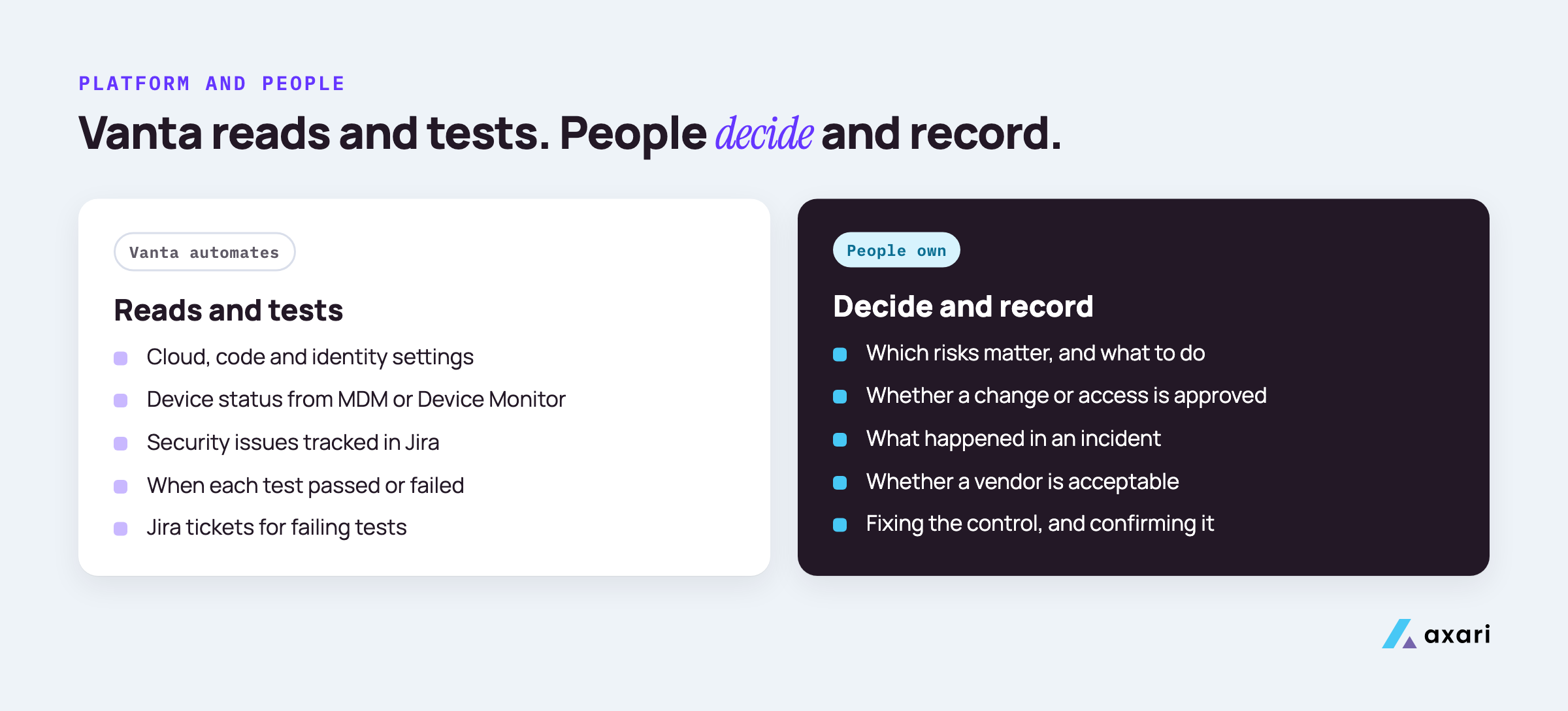
| Vanta reads and tests | People decide and record |
|---|---|
| Cloud, code and identity settings | Which risks matter, and what to do about them |
| Device status from an MDM tool or the Vanta Device Monitor | Whether a change or an access request is approved |
| Security issues tracked in Jira | What happened in an incident, and what changed after |
| When each test passed or failed | Whether a vendor's security report is acceptable |
Vanta's help center says its tests expect employee computers to have an MDM tool or the Vanta Device Monitor. MDM means mobile device management, the software that checks company laptops. And the Jira integration can import issues labeled as security issues as evidence, recording when each was created and resolved. Its vendor risk management can also pull findings from a vendor's SOC 2 report, so the reading goes faster. The decision on whether that vendor is acceptable stays with its risk owner, with security recommending; see vendor security assessment for the full review.
The right column is the judgment part of SOC 2, and by design it comes from someone accountable at your company.
What happens when a Vanta test fails, and who fixes it?
Vanta flags the failing test, and with Vanta Agent's agentic ticketing it can create the Jira ticket, assign it to the right owner and link it back. The fix belongs to whoever owns the system, usually an engineer or IT admin. Security makes sure the ticket gets worked, the fix is evidenced, and the test passes again.
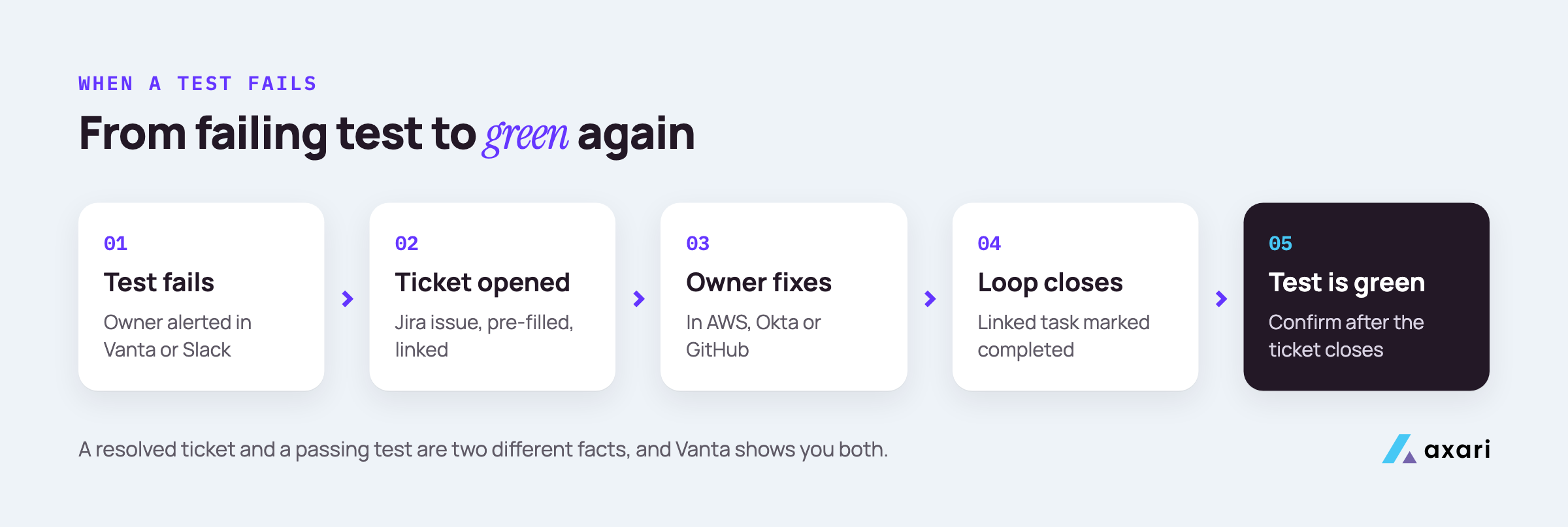
The path, as Vanta documents it:
- The test fails. The test owner is alerted in Vanta, and in Slack if they have turned that on.
- A ticket is opened. Vanta's Jira integration guide says you can create a Jira issue from a failing test in a few clicks, pre-filled with the failing details and remediation steps. You can also set a workflow per test so Vanta creates the issue when the test fails, and it skips creation if an open linked issue already exists.
- Vanta Agent can do it too. A product update dated 28 Aug 2026 says Vanta Agent can "create the Jira ticket, assign it to the right owner, and link it back", across documents, tests and risk scenarios.
- The owner fixes it in AWS, Okta or GitHub. For a failing cloud test, that means fixing the code and confirming the setting; see cloud misconfiguration remediation.
- The loop closes. When the Jira issue is resolved, Vanta marks the linked task completed on its next sync.
The step teams skip is the last check: confirming the test went green after the ticket closed. A resolved ticket and a passing test are two different facts, and Vanta shows you both.
Why is the auditor still asking for evidence when Vanta tests are passing?
A passing test shows a control is configured correctly now. A Type 2 auditor also samples whether controls operated across the whole period, and tests controls no integration reads: change approvals, access review sign-offs, incident handling, vendor reviews and risk assessments. Those requests arrive as samples, and the answers usually sit in tickets, approvals and email threads.
There are two reasons.
The auditor tests a period, not a moment. A Type 2 report covers an observation window of months. A green test today says nothing about a Tuesday in month four. Test history helps, but for many controls the auditor wants the record of the event itself.
Some controls are decisions. Say the auditor picks three access requests granted during the window. For each one they want the request, the manager's approval and the date access was granted, all dated inside the window. No configuration test can produce an approval that was never written down.
Keep those records as you go, linked to their control, so a sample is a lookup rather than a search.
For who should own each manual piece, see SOC 2 evidence collection for a lean team.
Do you still need a consultant if you use Vanta for SOC 2?
Not necessarily. A consultant is optional; the auditor is not. A consultant helps when no one inside has time to scope controls, write policies or prepare for the first audit. If someone internal knows your systems and security basics, Vanta's templates and guidance may be enough. The SOC 2 examination itself is always performed by an independent CPA firm.
It comes down to the people and time you have:
| You may want a consultant if | You may not need one if |
|---|---|
| Nobody inside has run a SOC 2 before | Someone has done it, here or at a past job |
| Scope is unclear: which systems, products or regions | Your scope is one product on one cloud |
| Your policies need writing from scratch to match how you work | Vanta's templates fit with light edits |
The audit firm must stay independent, so it tests your controls but will not design them for you. That is the space a consultant fills, often for the first audit only.
We have Vanta, but our GRC owner still spends hours chasing control owners. Why?
Because a platform can assign and remind, but the answer still has to come from a person busy with other work. Chasing shrinks when requests reach owners in Slack or Teams with the context attached. An AI Twin such as Axari can carry that follow-up after the ticket and prepare evidence for your approval and upload to Vanta.
Chasing usually has plain causes:
- The owner lives somewhere else. Engineers work in Jira and Slack, not in the compliance platform.
- The request lacks context. "Test failing" is less clear than "this bucket lost encryption, here is the fix, due Friday".
- Ownership is fuzzy. A control with no named owner defaults to the GRC owner.
Fix the basics in Vanta first: a named owner on every test, a due date per severity, and Slack notifications turned on by each owner.
What remains is the work after the ticket: following up with the owner before the due date, with the ticket's context attached, confirming the Vanta test has gone green once the ticket closes, and checking the source system for items no Vanta test covers. Give it to a named person with a fixed weekly slot, or to software that asks for approval before anything is sent. Vanta stays the system of record.
How should a CISO staff ongoing SOC 2 work after buying Vanta?
Staff it as a shared program across teams. Name one compliance owner to run the calendar, the platform and the auditor relationship. Make engineering, IT, HR and managers owners of their own controls, with due dates. Review open failing tests and overdue evidence monthly with leadership, so the follow-up has authority behind it.
Here is how the ownership splits:
| Role | What they own |
|---|---|
| Compliance owner | The Vanta workspace, the calendar, the auditor relationship, evidence quality |
| Engineering leads | Cloud and code controls, change approvals, fixes for failing tests |
| IT | Devices, onboarding and offboarding, identity settings |
| HR or People | Background checks, training, hire and leaver records |
| Managers | Access review decisions for their own teams |
| Risk owner or executive sponsor | Approving exceptions at the monthly review |
Keep the monthly review short: open failing tests, overdue tickets, evidence due and new exception requests. Remind owners directly first; bring in an owner's manager only for repeated misses or SLA breaches.
What will Vanta do each month, and what will a team of two still do?
Each month Vanta runs its tests, flags drift, tracks policy and training status, and can open Jira tickets for failures. Your team of two still triages those failures, chases fixes, verifies them, reviews new vendors and collects approvals. Add access reviews and open policy exceptions each quarter, and the risk assessment, policy review and audit preparation each year.
The same answer as a calendar:
| When | Vanta | Your team of two |
|---|---|---|
| Continuously | Runs tests, records history, alerts owners | Watches for failures on critical controls |
| Monthly | Opens Jira tickets for failing tests, if you set up the workflow | Triages failures, chases fixes, confirms tests pass again, reviews new vendors |
| Quarterly | With Vanta Access Reviews, pulls account lists from connected apps, notifies reviewers, sends reminders and records each decision | Chases late reviewers, removes denied access in each system, confirms the removal took effect, reviews open policy exceptions |
| Yearly | Holds policies, risk scenarios and audit evidence | Runs the risk assessment, approves policies, prepares for the audit |
The quarterly access review is often the heaviest item, because it depends on many reviewers and on removals made inside each app. Vanta's help center notes that it cannot currently write changes to your applications, so a denied account keeps its access until someone removes it there. See quarterly access reviews for SOC 2 for a walkthrough.
Frequently asked questions
How do I assign Vanta remediation tasks to engineers in Slack?
Set an owner for each test in Vanta, connect the Slack integration, and have each owner turn on Slack notifications in their own settings, since company-level setup does not switch on personal messages. Pair it with the Jira integration so the task lands in the engineer's queue, and agree on a due date per severity.
Vanta's help center explains where each person finds those settings in personal Slack notifications in Vanta.
How much time does SOC 2 take each week with Vanta for a founder?
Expect the heaviest load during setup and the first audit, then a steadier weekly rhythm of triaging failed tests, answering evidence requests and approving changes. How much time that takes depends on how many systems are connected and how many controls have owners other than you. Track your own hours for a month before planning.
What tools work alongside Vanta to close failing tests?
Start with what Vanta already connects to: Jira for tickets, Slack for notifications, and your cloud and code tools for the fix itself. If the follow-up is the bottleneck, look for a layer that chases owners, verifies each fix in the source system, and asks for approval before anything is sent.
Vanta or Drata for a small security team: what should you compare?
Compare them on your own stack rather than on feature lists: which of your systems each one integrates with, how your chosen auditor works with it, how manual evidence requests are assigned and approved, and pricing at your headcount. Both are established compliance platforms, so run a trial against your real controls before deciding.
Keep Vanta as the record, and staff the follow-through
Your next step: open Vanta, check that every test has a named owner, and look at how long failing items have stayed open. Vanta is enough for the platform side of SOC 2. The rest is your auditor and the people who own decisions and fixes.
Security tools find the work. Axari makes sure it gets done. A Twin works on top of Vanta to keep you audit-ready: it follows up with owners in Slack or Teams after each ticket, confirms the fix shows up in Vanta, and prepares evidence for your approval and upload. You keep the judgment, and nothing is sent or changed without your approval. Request a demo to see how it fits your Vanta setup.