
Snyk says hundreds of your findings are critical. Wiz agrees, and adds more of its own. Your team has two engineers and one sprint. Something has to wait, and you need a reason that holds up when someone asks why.
CVSS, EPSS and KEV answer different questions. CVSS rates how severe a flaw is. EPSS estimates how likely it is to be exploited soon. KEV tells you it already has been. Used together in a fixed order, they give you a short list your team can finish.
This article explains each signal, how to set an EPSS cut-off, how to map tiers to SLAs, where SSVC fits and how to explain a priority to the engineer doing the fix.
CVSS vs EPSS vs KEV: what is the difference?
CVSS measures how severe a vulnerability is, on a 0 to 10 scale. FIRST's EPSS model estimates the probability it will be exploited in the next 30 days. CISA's KEV catalog lists vulnerabilities already known to be exploited. So you get one score for severity, one for likelihood and a list of evidence. None of them knows whether the affected asset matters to your business.
All three refer to the same IDs. A CVE is the public ID given to one known security flaw, such as CVE-2021-44228, the Log4j flaw known as Log4Shell.
| CVSS | EPSS | KEV | |
|---|---|---|---|
| Full name | Common Vulnerability Scoring System | Exploit Prediction Scoring System | Known Exploited Vulnerabilities catalog |
| Maintained by | FIRST | FIRST | CISA |
| Question it answers | How bad could this be? | How likely is exploitation in the next 30 days? | Has it been exploited in the wild? |
| Output | 0 to 10 | 0 to 1, plus a percentile | Listed or not listed |
| How often it changes | Rarely | Daily | Entries are added over time |
What none of them can see is your environment. They do not know whether the vulnerable package is actually loaded, whether the server faces the internet, or whether it holds customer data. That context has to come from you: your asset inventory, your cloud tools and the people who own each system.
What is an EPSS score?
An EPSS score is FIRST's daily estimate, from 0 to 1, of the probability that a CVE will see exploitation activity in the next 30 days. Each score comes with a percentile showing how the CVE ranks against all others. Scores change as new threat data arrives, so read each one as of the day you pulled it.
Every EPSS lookup returns two numbers that are easy to mix up.
- The probability is the score itself. A value of 0.30 means FIRST's model puts the chance of exploitation activity in the next 30 days at about 30 percent.
- The percentile shows rank. A CVE at the 95th percentile scores higher than 95 percent of all scored CVEs.
Many CVEs have low probabilities, so a score that looks small can still rank high. When you write rules, say whether you mean the probability or the percentile.
FIRST publishes a score for every published CVE each day, with a free API and daily CSV downloads, all linked from FIRST's EPSS page.
Because scores move, record the date next to any EPSS value you copy into a ticket. A finding that scored low last month can score high today if exploit code appears.
What is the CISA KEV catalog?
CISA's Known Exploited Vulnerabilities catalog is a public list of CVEs with evidence of exploitation in the wild. CISA's BOD 26-04, which superseded BOD 22-01 in June 2026, sets remediation timelines for US federal civilian agencies only. Private companies are not bound by it, but the catalog is one of the strongest signals for what to fix first.
The catalog is free, and you can download it as CSV or JSON from CISA's KEV catalog page. Each entry names the CVE, the affected product, a short description, the required action, a due date for federal agencies, whether the flaw is known to be used in ransomware campaigns and whether BOD 26-04 requires forensic triage.
CISA's own page tells organizations to treat the catalog as one input to how they prioritize. KEV gives you evidence of exploitation, and you still supply the context. A KEV-listed flaw on a server you retired last year is not urgent. A KEV-listed flaw on your login page is.
The federal rules changed on June 10, 2026, when CISA revoked BOD 22-01 and issued BOD 26-04. Agencies now set each deadline from four factors: asset exposure, KEV status, exploit automation and post-exploitation technical impact. KEV status is still one of them, and the directive still binds only federal agencies.
Is CVSS enough for vulnerability prioritization?
No. CVSS describes how bad a vulnerability could be. It says nothing about how likely it is to be used against you. Sorting by CVSS alone marks a large share of findings as high or critical, more than a small team can fix in any sprint. Use it as one input, alongside exploitation evidence and your own asset context.
The number most scanners show is the CVSS Base score. It describes the flaw itself. CVSS also has metric groups for threat activity and for your own environment (called Threat and Environmental in CVSS version 4), but few teams fill them in, so the score you see usually ignores both.
That creates two problems for a small team:
- Too many criticals. When a big part of the backlog is labeled high or critical, the label stops helping you choose.
- The wrong order. A 9.8 on a machine no outsider can reach can sit above a 6.5 that attackers are using today on an exposed service.
Keep CVSS. It describes impact well, and customers and auditors expect to see it. Use it to break ties after exploitation evidence and exposure, rather than as the only sort key.
How do you prioritize vulnerabilities using EPSS and KEV?
Use a fixed order. First, anything in CISA's KEV catalog or actively exploited, on an asset an attacker can reach. Second, high EPSS scores on internet-facing or sensitive systems. Third, the remaining high CVSS findings, weighted by exposure. Write the order down, so engineers and auditors can see the same rule your team applies every week.
A written rule you can copy and adjust:
Priority rule. We fix in this order. 1: CVEs in CISA's KEV catalog, or otherwise known to be exploited, on assets we run that an attacker can reach. 2: CVEs at or above our current EPSS cut-off on internet-facing systems or systems that hold customer data. 3: CVSS high or critical on the remaining assets, internet-facing first, as planned work. 4: everything else, in a backlog we review. We review the EPSS cut-off every quarter.
The rule holds up when you do three things:
- Automate the sort. Many scanners now show KEV status or EPSS on each finding, and some let you filter by them. Snyk's Risk Score, in early access, factors in EPSS. Check yours before you build a spreadsheet.
- Apply it the same way every week. If you skip steps whenever a loud request arrives, engineers learn that the rule is negotiable.
- Log overrides. Sometimes a lower item jumps the queue. Write down why, on the ticket.
What is a good EPSS score threshold?
There is no official universal EPSS threshold, and FIRST does not set one. Pick a cut-off from capacity: sort open findings by EPSS, count how many fixes your team can ship per sprint and draw the line there. Review it every quarter, and prefer a line your team can meet over a strict one that gets ignored.
To find your line:
- Export open findings on internet-facing or sensitive systems, leaving out the KEV tier.
- Group them by fix.
- Sort the fixes by the highest EPSS score each one resolves.
- Ask engineering leads how many security fixes they can take per sprint, on top of KEV work.
- Count down the sorted list to that number. The EPSS value at that row is your cut-off for now.
Say your team can take about ten fixes a sprint, and the tenth fix on the list scores 0.2. Then 0.2 is your working threshold. If the list above the line keeps growing, you need more capacity or a narrower scope, and your own backlog numbers make that case to leadership.
You will see many different cut-offs quoted online. FIRST's own article on probability, percentiles and binning says no single cut-off is right for everyone.
Too many critical vulnerabilities: which should a small team fix first?
Fix KEV-listed or actively exploited findings on reachable assets first, then high-EPSS findings on internet-facing or sensitive systems, then whatever fits the capacity left. If Snyk and Wiz both flag hundreds of criticals, deduplicate by CVE and by fix, since one upgrade often closes many findings. Two engineers can finish a short, ordered list; they will never finish hundreds of criticals.
When two tools flag the same issues, the first job is to make one list.
- Merge by CVE and asset. Snyk often reports a vulnerable package in code or in a container image. Wiz may report the same CVE on the running workload built from that image. Treat both as one finding.
- Merge by fix. Map each CVE to the change that removes it: a package version, a base image, an operating system patch. Count fixes, not findings.
- Apply the rule. KEV or active exploitation on reachable assets, then high EPSS on exposed or sensitive systems, then capacity.
- Cap the sprint. Give the engineers a list that fits. If it is too long, cut from the bottom, not the top.
So trust KEV first, because it is evidence of exploitation. Use EPSS to order what is left. Use CVSS to break ties and to describe impact. None of the three should decide the sprint on its own, and none of them replaces knowing which assets matter.
What does a risk-based vulnerability prioritization model look like?
A simple model has four tiers. P1: KEV-listed or actively exploited, on a reachable asset. P2: high EPSS on an internet-facing or sensitive asset. P3: high CVSS with no exploitation signal. P4: everything else. Each tier gets an owner and an SLA. Compensating controls can lower a tier if you record the reason on the ticket.
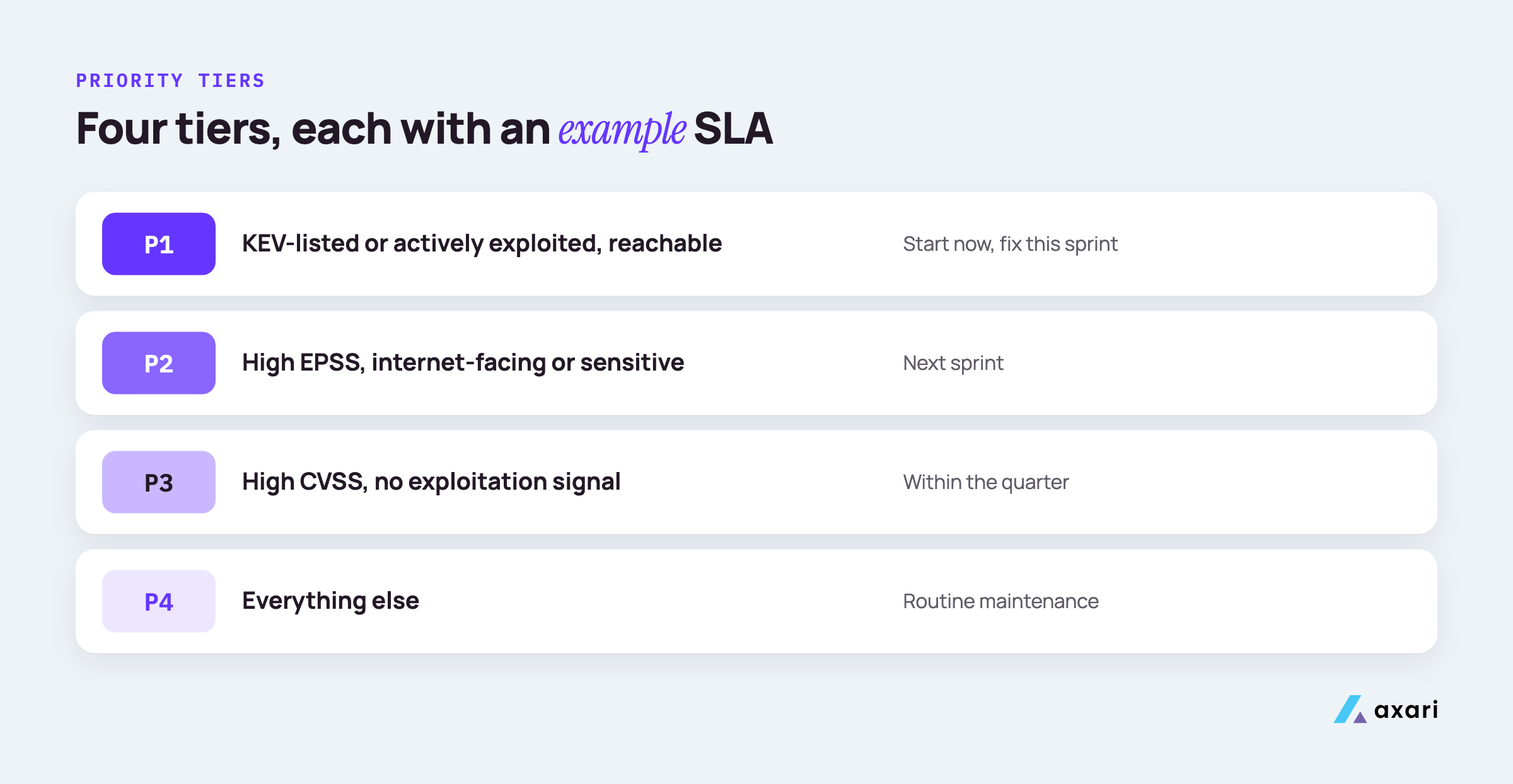
An SLA (service level agreement) is the deadline you promise for each tier. Pick targets your team already meets most of the time, then tighten them. The clock starts at detection, and an SLA counts as met only when a rescan confirms the fix, as covered in How to verify vulnerability remediation after the ticket closes.
| Tier | What qualifies | Example SLA | Who owns it |
|---|---|---|---|
| P1 | KEV-listed or actively exploited, reachable | Start now, fix this sprint | Owning team, security checks daily |
| P2 | High EPSS, internet-facing or sensitive | Next sprint | Owning team |
| P3 | High CVSS, no exploitation signal | Planned work | Owning team |
| P4 | Everything else | Backlog, reviewed | Owning team |
Compensating controls are protections that reduce the risk without the patch, such as a web application firewall rule that blocks the attack path, or turning off the vulnerable feature. They can move a finding down a tier. Write the control and who confirmed it on the ticket, and set a date to check again.
Cloud misconfigurations have no CVE, but the same four tiers apply, with "publicly exposed" standing in for "internet-facing", as in cloud misconfiguration remediation. For the owners, tickets and follow-up around these tiers, see Vulnerability management for a small security team.
SSVC vs EPSS: which prioritization framework should you use?
Use EPSS as an input and SSVC as a decision method. SSVC, a decision-tree approach from CERT/CC and CISA, asks about exploitation, exposure, automatability and impact, then points to an action. A small team can borrow its questions without running the full tree, and use EPSS and KEV to answer the exploitation question.
SSVC stands for Stakeholder-Specific Vulnerability Categorization, created by CERT/CC at Carnegie Mellon University's Software Engineering Institute, working with CISA. Two versions are worth knowing:
- CERT/CC's deployer model is for teams that run the software. Its decision points are Exploitation (none, public proof of concept, active), System Exposure (small, controlled, open), Automatable (yes or no) and Human Impact (low to very high). It ends in Defer, Scheduled, Out-of-Cycle or Immediate.
- CISA's version uses Exploitation, Technical Impact, Automatable, Mission Prevalence and Public Well-being Impact, and ends in Track, Track*, Attend or Act. CISA offers a free calculator on its SSVC page.
A light version for a small team is four questions on each top finding. Is it exploited, or does it have a high EPSS score? Can outsiders reach it? Could an attacker automate the attack? Would it hurt customers or the business? A reasonable starting rule: if it is exploited and outsiders can reach it, it is P1. If it has a high EPSS score and outsiders can reach it, it is P2.
How do you explain to developers why a CVSS 9.8 can wait but a CVSS 6.5 can't?
Show them the evidence behind the order. The 6.5 may be in CISA's KEV catalog and sit on an internet-facing service, while the 9.8 sits on an internal system attackers have no route to. Put the reason on the ticket in one line: exploitation status, EPSS and exposure. Engineers accept priorities they can check for themselves.
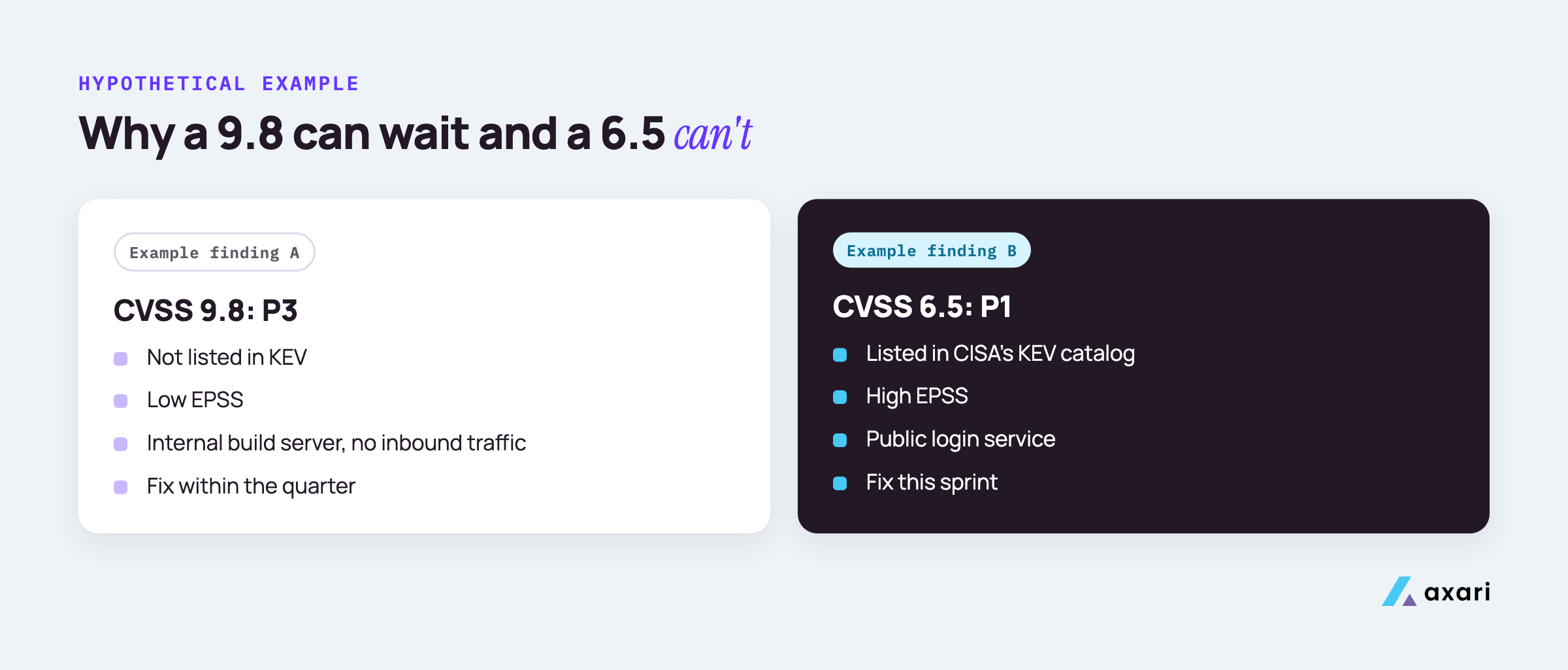
Take a hypothetical pair, laid out the way the tickets could read.
| Finding A | Finding B | |
|---|---|---|
| CVSS | 9.8 | 6.5 |
| KEV | Not listed | Listed |
| EPSS | Low | High |
| Exposure | Internal build server, no inbound traffic allowed | Public login service |
| Tier | P3, planned work | P1, this sprint |
The one-line reason for B: "In CISA's KEV catalog, high EPSS, on our public login service." For A: "Severe if reached, but no exploitation signal and no outside access."
A few habits build trust. Link the KEV entry and the EPSS lookup so engineers can check the facts themselves. Use the same words on every ticket. When a developer pushes back with new facts, for example that the vulnerable function is never called, listen and re-tier.
Frequently asked questions
How do you add EPSS and KEV data to Jira tickets?
Add custom fields for EPSS score, EPSS percentile and KEV status, then fill them from FIRST's EPSS data and CISA's KEV feed when the ticket is created. Refresh the EPSS fields regularly, since scores change daily. Check your scanner's Jira integration first, because some already add these fields for you.
Is there a vulnerability prioritization matrix template?
Yes. A prioritization matrix puts exploitation evidence on one axis and asset exposure on the other, with each cell mapped to a priority tier and an SLA. The four tiers in this article give you a version to copy and adjust to your team's real capacity.
Do CISA's KEV deadlines apply to private companies?
No. CISA's KEV deadlines come from binding directives for US federal civilian agencies: BOD 22-01, superseded in June 2026 by BOD 26-04. Private companies have no obligation to meet those dates, though many use the KEV catalog as a priority signal and set their own SLAs for KEV-listed findings.
Write the rule down this week
Write your four-tier rule on one page, pick an EPSS cut-off from this sprint's real capacity and agree the SLAs with your engineering leads. Put the one-line reason on every ticket, and review the cut-off each quarter.
The rule decides what to fix. Keeping critical vulnerabilities within policy takes the follow-up after it: nudging owners, checking the rescan, gathering evidence. Axari is the AI workforce for cybersecurity teams, and an AI Twin carries that follow-up in Slack or Teams, on top of the scanners you already use. You keep the judgment, and nothing is sent or changed without your approval. To see it on your own findings, request a demo.