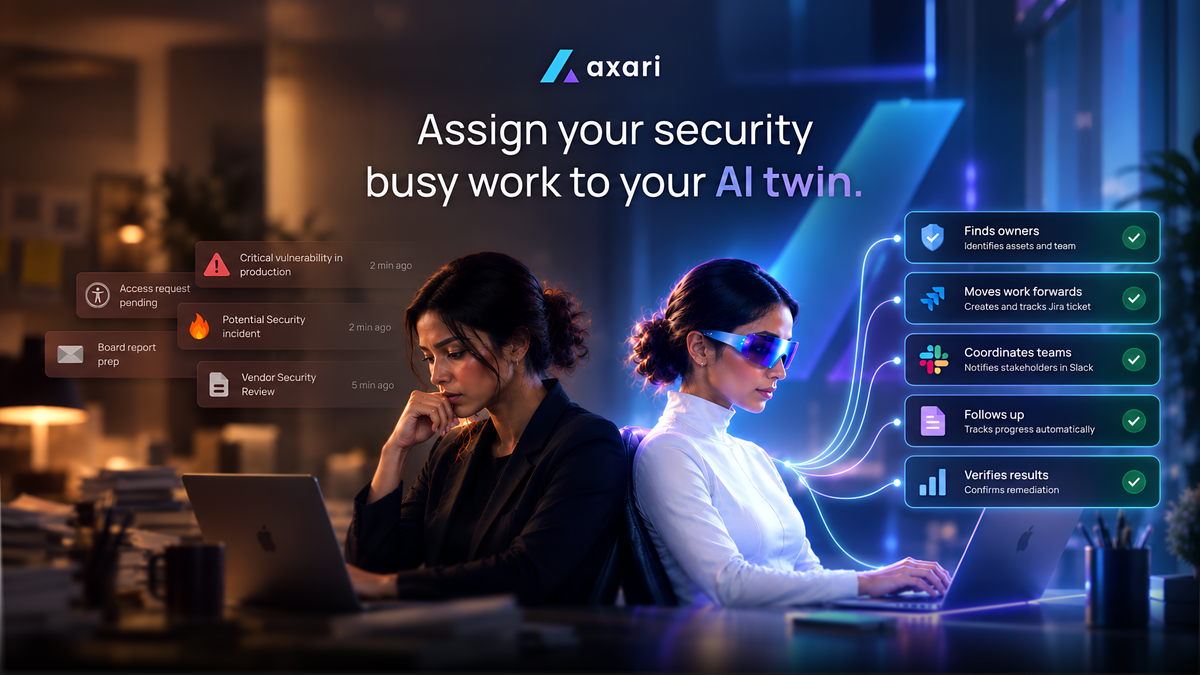

Every person on your security team now gets an AI Twin: a colleague that works inside Slack, across the tools and people you already have, and keeps a piece of security work moving until it is actually done. Hand it work. It comes back when a decision is yours to make.
Meet your AI Twin → Request a demo →
Introducing Axari Twin
Tuesday, 4:47pm
A critical finding lands from your secrets scanner. An AWS access key is exposed. It is active, it is tied to a production integration, and the integration is tagged to a person who left the company in March.
You know what happens next because you have done it a hundred times.
You open the finding. You open IAM to see what the key can touch. You search Slack for the integration name and find a thread from last year where someone mentioned it. You ping their old manager. She points you to a new owner. You write a Jira ticket with enough context that Engineering will not bounce it back. You post in their channel. You add it to the list in your head.
Thursday, Engineering replies: we need to check what breaks if we rotate it, give us until next sprint. You say fine, and you mean to update the ticket later. Two more criticals have landed since Tuesday. The new deadline lives in a Slack thread and in your memory, nowhere else.
Three weeks later, in the audit, the ticket is closed. The key is still active.
Closed is not the same as gone.
Every security team knows this. The gap between the two is where the real work lives, and today it is carried by a handful of people in their heads, their inboxes, and their Slack threads.
We built Axari for that gap.
The same Tuesday, with a Twin
Same finding. Same orphaned integration. Before you have read the alert, your Twin has pulled the finding, checked in IAM what the key can reach, found that the tagged owner is gone, traced the integration to its current team through org data and recent commits, checked that no remediation is already open, created the Jira with the context Engineering needs, and asked them one question in their channel: can this service take a newly issued credential without downtime?
Thursday, Engineering replies: yes, no downtime, but we are heads down until next sprint.
This is the moment a copilot hands the whole thread back to you. Your Twin hands you one action instead:
Your Twin:
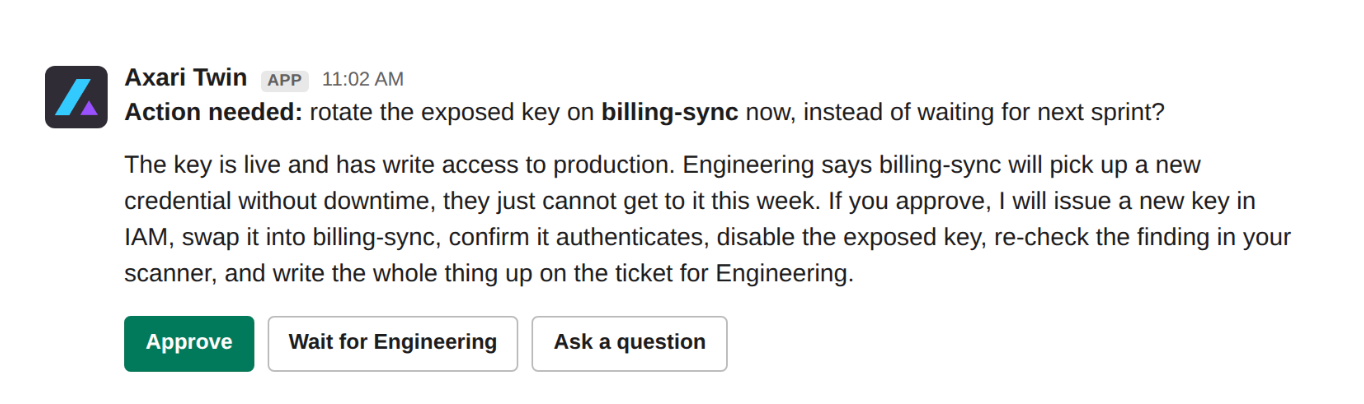
You tap approve between meetings. Twelve minutes later the old key is dead, billing-sync is running on the new one, the scanner shows the finding cleared, and the ticket has a note Engineering can read in thirty seconds. The finding is marked done only because the scanner says so.
Twelve actions. Four systems. Two teams. One decision from you. Closed on Thursday, not after the audit.
I wanted a teammate that actually moved work forward. Not just a copilot.
Jake Bernardes, CISO, Gambit
Ask it. Or don't.
You can hand your Twin work the way you would hand it to a colleague: investigate this finding, prep me for the leadership review, pull the evidence for this control, tell me what is slipping. It gathers context, works across your tools, and comes back with the result.
But that key did not wait for a prompt, and neither does your Twin. It notices when a critical finding appears, when evidence goes stale, when an owner has not responded, when an initiative is drifting. It starts moving the work before you ask, and anything consequential waits for your yes.
And it stays with the work. Some of it takes an afternoon. Some of it takes six weeks and three owners. Your Twin remembers what happened, who owns what, what was decided, what is blocked, and what has to happen next.
Where this came from
We spent the last year sitting with 60+ CISOs and their teams, and we kept hearing the same Tuesday. Different tools, different findings, same shape: the tool surfaces the work, and then a person becomes the middleman between four systems and three teams until it is done, or until it is forgotten.
The exposed key is one pattern. Axari now runs 100+ security workflows built for every role on the team, and each one has a definition of done.
Critical exposure
Finding, owner, remediation, verification. Done when the exposure is confirmed gone, not when the ticket is closed.
Continuous compliance
Controls, evidence, owners, remediation. Done when evidence is current in March, not just during audit week.
Vendor onboarding
Request, evidence, risk, decision. Done when the review is complete and the decision is on the record.
Access assurance
Review, decision, revocation, verification. Done when the access is actually gone.
Your tools already show you the work. Your Twin does the part between the alert and the outcome, across tools, teams, and time.
We couldn't hire more people; we hired Axari.
Nikhil Sud, CIO, Boyd Corp
It learns how security works here
Your Twin starts with the tools and responsibilities you give it. Then it learns your organization: who really owns what, how work gets routed, which policies apply, what an exception looks like, and when you want to be in the loop.
Go back to that key rotation. After a few of those, your Twin knows you check with your engineering lead before it touches a production credential, and offers to loop him in first. After a few more, it knows which findings you never want to hear about until they are done.
Real work needs real trust
Giving an AI real responsibility needs a different level of control than giving it questions to answer. Every step of that Tuesday runs on these rules.
- Scoped, opt-in access. Each person connects their own tools and can revoke them anytime.
- Human approval for consequential actions. Nothing is sent, posted, or written to your systems without your yes.
- Private to you. Your Twin's work and memory are visible to you, not to your admin, not to anyone else.
- On the record. Every action lands in an audit trail you can inspect.
- Never trained on your data. Your data stays yours.
We brought in Axari to give our security program autonomous governance and task-level agency.
Rohit Parchuri, CISO, Yext
You + your AI Twin
AI is changing what attackers can do. It should change what defenders can do too. Not by replacing security professionals, but by giving each of them another set of eyes, another set of hands, and another version of themselves that keeps the work moving when their attention is somewhere else.
Attackers are not going to use less AI. Defenders shouldn't either.
No training. No long onboarding. Axari showed up in Slack and immediately started delivering value to me and my team.
Malcolm Harkins, CISO, HiddenLayer
Your Twin is ready in about ten minutes and useful inside the first ten. Start free, with enough credits to run your daily brief and a lot more.
Meet your AI Twin → Request a demo →
Slack today. Microsoft Teams next.