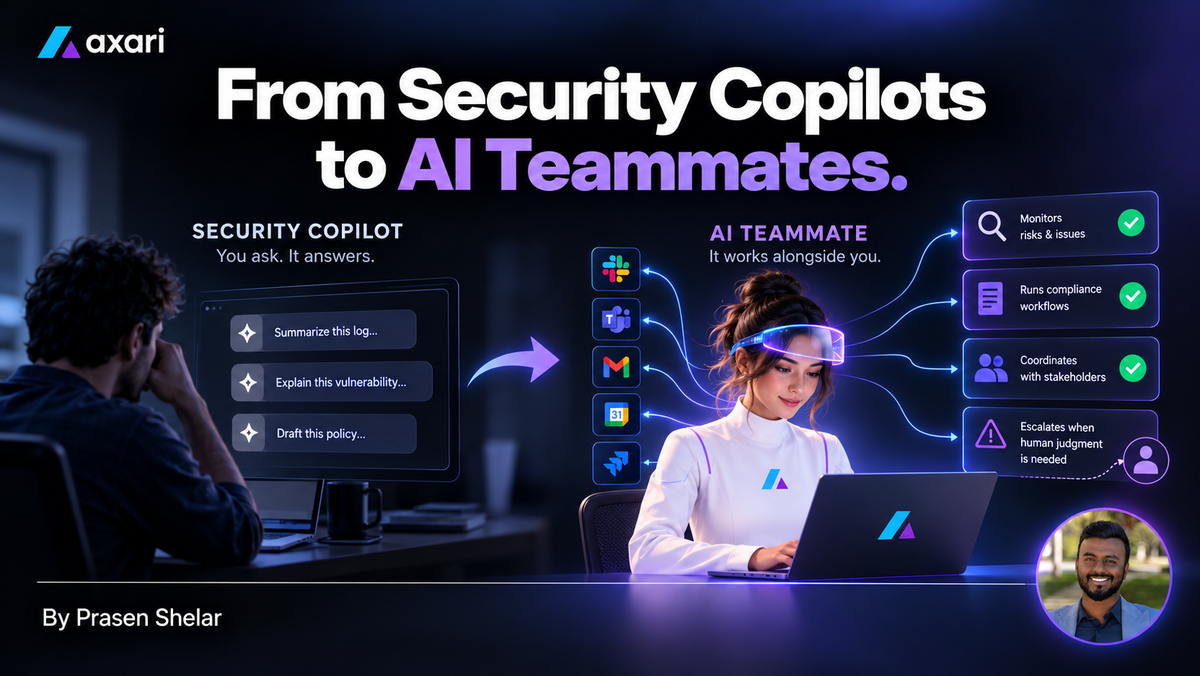

The last few years in security AI has been defined by the copilot model: you give a task, the AI works it. Summarize this log. Explain this vulnerability. Draft this policy. It is genuinely useful, and it is also fundamentally limited by the same constraint as every tool before it. It only works when a human has the time and bandwidth to invoke it.
Something more significant is emerging, and the framing shift matters: from AI you use to AI that works alongside you.
The architectural difference
A copilot is a reactive interface. It processes a prompt and returns a result. The entire capability depends on a human initiating the request. When the human is overwhelmed or unavailable, the copilot sits idle.
An AI teammate operates differently. It holds context across time. It initiates when it detects something that needs attention. It executes multi-step workflows across systems without requiring a human to orchestrate each step. And critically, it hands off to a human when it reaches a decision point that requires judgment, authority, or accountability.
This is not just a capability improvement. It is a different model of what AI does in a security organization. The copilot augments how you respond to inputs. The AI teammate changes what happens when you are not actively paying attention.
What this means for the CISO's charter and leadership
The operational implications are significant. A standing audit of remediation ticket state, running continuously, will catch far more stale closures than a periodic human review. A vendor coordination workflow that runs on schedule rather than when someone remembers will not slip during a busy quarter. A proactive brief that synthesizes the state of open commitments across email, tickets, and calendar will surface the follow-up that was about to fall through before it actually falls.
These are not edge case improvements. They are the core of what makes a security program reliably close the loop on the work it has already decided to do.
The accountability architecture
The question that comes up immediately is: where does the human stay in control?
The answer is that well-designed AI workforce systems are built around explicit handoff points. The AI executes what it can and escalates what it cannot. The design philosophy should be: AI holds the work in motion, humans make the calls that matter.
Risk acceptance belongs to a person. Board communications require a person. Decisions that carry legal or organizational accountability need human ownership. Everything else, the follow-through, the coordination, the context-assembly, the standing operational cycles, can and should be carried by AI.
The organizations that implement this well will not look like they replaced their security teams. They will look like their security teams got dramatically more productive.
The Shift Every Security Team Must Make
We are early in this shift. Most organizations are still in the copilot phase, and that is fine, it is a real improvement. But the teams that start thinking now about what AI workforce capacity means for their org design, their operational processes, and their risk governance will be better positioned when the rest of the market catches up.
The question is not whether security AI will move from copilot to employee. That transition is already underway. The question is which organizations build the architecture to support it intentionally, rather than finding out after the fact what they should have built.
__________________________________________________