
By Surjit Ahluwalia
Every significant shift in enterprise technology has followed a similar pattern. The capability arrives before the architecture is understood. Early adopters make real progress and also make real mistakes. The organizations that end up ahead are the ones that thought carefully about where the new capability fits in their existing ecosystem rather than deploying it in isolation.
We are at that point with AI workforce systems in enterprise security.
The capability is clearly real. AI agents can hold context, execute multi-step workflows, integrate across systems, and operate continuously without requiring constant human direction. The question is not whether this is useful. The question is how you integrate it into an enterprise environment that was built around a different model of how work gets done.
The integration question
Most enterprise security environments have accumulated toolchains over years. Ticketing systems, SIEM, IAM, communication platforms, compliance tools, email. The data that matters for running a security program is distributed across all of them, and the coordination work that makes the program function happens in the spaces between them.
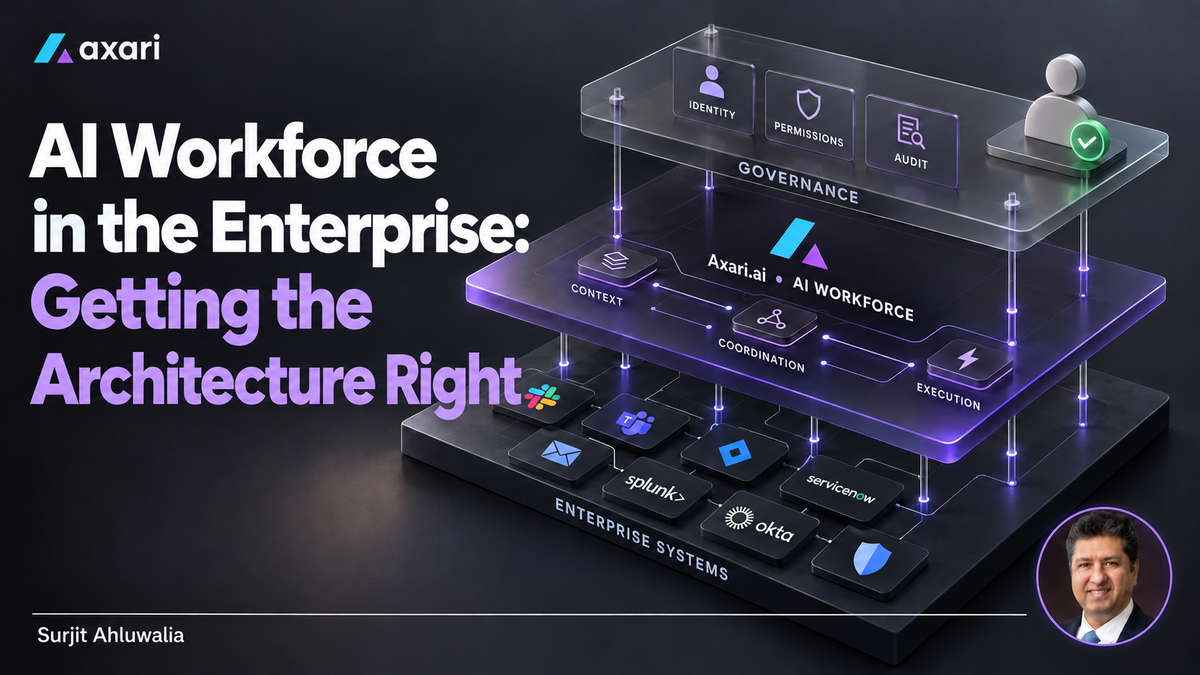
AI workforce systems that operate only within a single tool deliver limited value. The coordination layer, the work between tools, is where the real gap is. An AI teammate that can move a context-assembled handoff from a Slack conversation into a Jira ticket into an email to a vendor and back, while tracking state across the whole chain, is doing something that no single-tool integration can replicate.
This means the integration architecture is not a secondary concern. It is the primary determinant of how much value you will get. AI systems that treat integration as a feature list will underperform systems where the cross-tool context layer is the architectural center of gravity.
The identity and access layer
Enterprise deployment of AI workforce systems introduces a set of questions that most organizations have not had to answer yet: what permissions does the AI have, where does it act on behalf of a specific user versus operating as its own principal, and how do you audit what it has done?
These are not academic questions. They are prerequisites for getting AI workforce systems into production in any organization with meaningful security and compliance requirements. The vendors and platforms that have thought through this architecture carefully will be the ones that enterprise security teams can actually deploy.
The ideal model is one where the AI operates with well-scoped, auditable permissions, integrates with existing identity and access management rather than bypassing it, and produces clear logs of what it did, what it escalated, and why. That level of transparency is what allows security leaders to expand AI scope over time as trust is established.
The change management reality
The final piece that is often underestimated is the change management dimension. AI workforce systems change how security teams work. Some workflows that were manual become automated. Some decisions that were made ad hoc get formalized as standing automations. Some roles shift in scope.
Organizations that introduce these systems without thinking through the human side tend to get uneven adoption and underestimate the value they have deployed. Organizations that treat AI workforce integration as an operational change management initiative, not just a technology deployment, get much better outcomes.
The platform and ecosystem story for the AI workforce in enterprise security is still being written. The organizations that get involved early, think carefully about integration architecture, and invest in the change management layer will have a real advantage when this market matures.
__________________________________________________
Surjit Ahluwalia is a technology and security executive and advisor to Axari.