
In Part 1, I imagined what a day might look like if a CISO had something like an AI Chief of Staff helping assemble context across the security program.
Not another dashboard. Not another security tool. Something closer to an operating system for the security team. A system that understands how work actually flows through the organization and helps assemble the context leaders need to make decisions.
But that scenario raises a deeper question -- what happens when AI systems begin to learn how security organizations actually make decisions?
Because the reality of the CISO role is that decisions rarely come from a single data point. They come from a combination of signals across the organization.
An engineering team reports a deployment delay. A compliance team flags an upcoming audit deadline. Threat intelligence changes the perceived risk of a vulnerability. Finance challenges the budget for a security initiative.
None of these signals exist in isolation. They exist in context.
Over the years, I have watched CISOs spend an extraordinary amount of time reconstructing that context before they can even begin to make a decision. And much of the job of a security leader is holding all of that context together long enough to determine what actually matters.
The Missing System of Record in Security
Security organizations already have systems of record for many things. There are platforms that track vulnerabilities. Systems that capture incident data. Asset inventories that map infrastructure. Repositories that store compliance evidence.
The industry has built systems to store alerts, logs, and assets, but there is one thing most organizations do not have a system of record for – how security decisions are made.
- Why was a particular risk accepted instead of remediated?
- Why was one initiative prioritized over another?
- Why was a control implemented in one environment but not another?
Those decisions rarely live inside security tools. More often, they exist in Slack threads, meeting notes, hallway conversations, or someone’s memory.
Over time, that context disappears.
I have stepped into security programs where entire decision histories had to be reconstructed from fragments of conversation. A Slack thread here. A half-remembered discussion there. A document someone saved two years ago.
Security teams inherit tools, policies, and architecture. But they often do not inherit the reasoning behind them. Security programs accumulate technical infrastructure over time, but their decision context is surprisingly fragile.
The Institutional Memory Problem
This becomes most visible when people leave. A senior engineer moves to a new company. A program manager transitions into another role. A CISO hands the organization to a successor.
Along with them goes a significant amount of institutional knowledge about how the program actually operates.
- Why do specific controls exist?
- Which risks has the organization historically prioritized?
- How engineering teams typically respond to security requirements.
Anyone who has stepped into a new security leadership role recognizes this moment. You inherit a security program that clearly reflects years of decisions, but you cannot always see the logic that produced them.
It takes months to reconstruct that context. Sometimes years. And even then, pieces of the story remain missing.
What If Security Programs Could Remember?
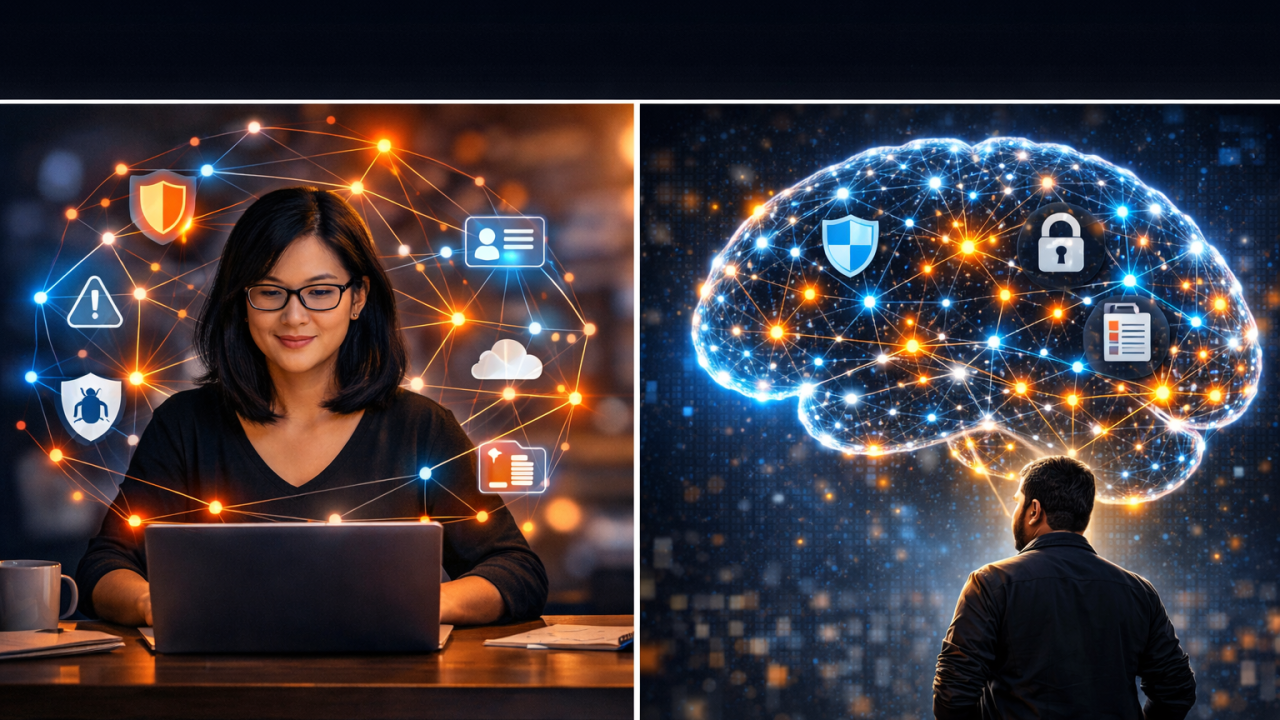
Now imagine a system that quietly observes how the security organization operates every day.
It sees conversations between security and engineering teams. It sees how incidents are escalated, how vulnerabilities are prioritized, and how risk decisions are debated.
Over time, patterns begin to emerge.
The system learns that this organization consistently prioritizes identity risk over endpoint risk. It learns that leadership tends to focus on systemic risk reduction rather than chasing individual vulnerabilities. It learns how engineering teams typically respond when security proposes a new control.
None of this replaces human judgment. But it captures something security programs have historically struggled to preserve -- how the organization actually thinks about security.
And once those patterns are captured, something important begins to happen. The security program develops memory.
The Difference Between Context and Judgment
Many AI systems today focus on providing more context. They summarize documents, surface alerts, and gather information from across tools. That is useful. But context alone does not solve the hardest part of security leadership.
The hardest part is judgment. Context is information about security. Judgment is knowing what to do about that information in a specific organization, at a specific moment, with specific tradeoffs.
Context can often be found on the public internet. But judgment cannot. Judgment comes from experience. It comes from understanding how risk, engineering velocity, regulatory pressure, and business priorities interact inside a particular organization.
If AI systems are going to meaningfully support security leadership, they cannot simply surface information.
They must begin to understand how decisions are made.
From Security Tools to Security Operating Systems
This idea also changes how we might think about security platforms. For decades, security technology has largely focused on solving individual technical problems. There are tools for endpoint security, vulnerability management, identity protection, and many other domains.
Each tool addresses a specific category of risk. But the job of a CISO is not simply managing tools. The job is making decisions across the entire security program.
Security leaders constantly translate signals between teams. Tools generate alerts and data, but leaders must interpret what those signals mean for the organization.
If AI systems can learn the decision patterns of a security organization, they could begin to function as something more foundational. Not just tools. Operating systems for security programs. Systems that sit above the individual technologies and help assemble signals into decisions.
The goal is not automation for its own sake. The goal is clarity -- helping security leaders see the full context of the program so they can focus on the decisions that matter most.
Execution, Not Just Productivity
Another way to think about this shift is the difference between productivity and execution.
- A productivity tool helps a security leader work faster.
- An execution system helps the organization actually run.
Imagine a system that not only gathers context, but also understands the cadence of how the security program operates. It knows how board reporting works. It understands the rhythm of audit preparation. It recognizes when a program initiative begins drifting off track. Instead of waiting for someone to ask the right question, the system becomes responsible for helping maintain the operating rhythm of the program.
That is not simply productivity. That is execution.
AI Does Not Replace Security Teams
Whenever discussions about AI enter the security field, the same concern quickly appears. Does this mean fewer security professionals? That is not the future that seems most plausible.
Security teams are already overwhelmed with operational work. Alert triage, vulnerability remediation, compliance reporting, and cross-team coordination consume enormous amounts of time.
Most security leaders would welcome systems that reduce operational friction. AI systems are extremely good at assembling context across large volumes of signals and identifying patterns across complex environments.
Humans remain far better at judgment, leadership, and navigating the tradeoffs between security, engineering velocity, and business priorities.
The future that seems most realistic is not replacement, it is collaboration. AI systems help assemble context. Security leaders and their teams make the decisions.
The Real Transformation
The most important shift here is not automation. Security tools have been automating tasks for years. The deeper transformation is memory.
For the first time, security organizations may have systems capable of remembering how the program actually evolved. What risks were debated? What tradeoffs were made? What decisions shaped the security architecture of the organization?
For decades, security programs have depended heavily on the experience and intuition of a small number of individuals.
But if security organizations begin to capture their institutional decision memory, something important changes. The program itself becomes more resilient. Leadership transitions become smoother. Hard-earned operational knowledge no longer disappears when someone leaves.
In a field where institutional knowledge has historically walked out the door every time a security leader changes roles, the ability for a security program to remember its own decisions may turn out to be one of the most important capabilities AI introduces to security leadership.