
How 60+ CISOs use Axari to run security like a business, and why it is becoming the operating system for AI-native security organizations.
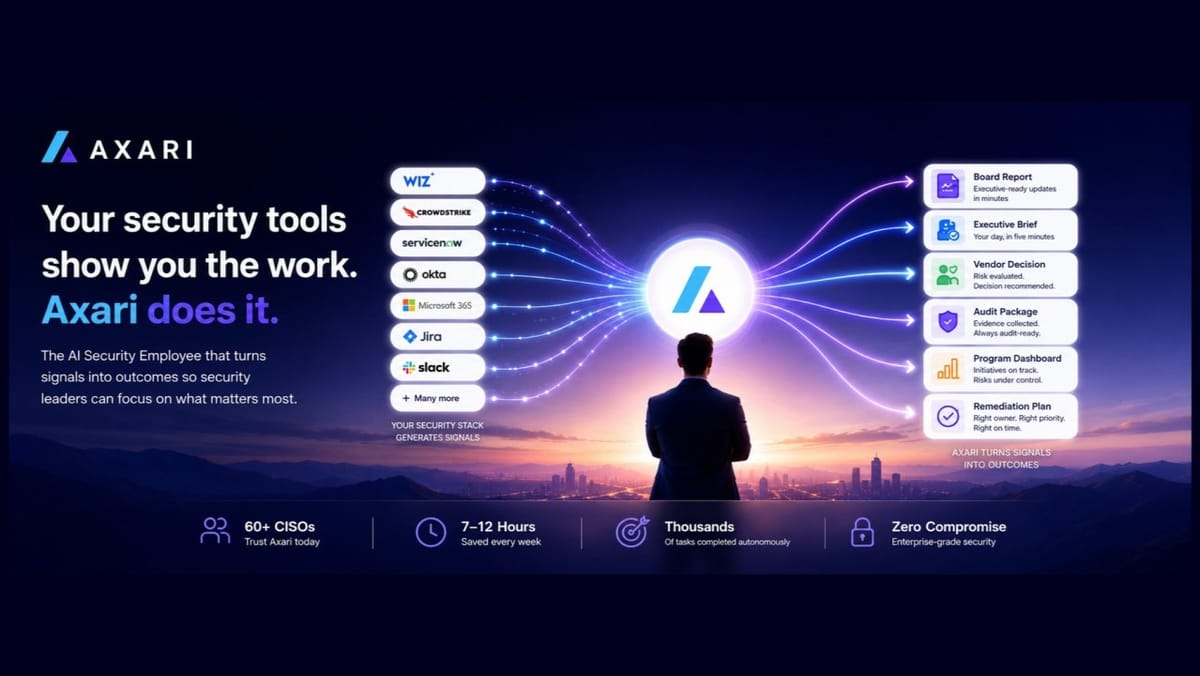
Walk into almost any security organization and you find the same thing: a team surrounded by excellent tools and still buried in work. Wiz finds the exposures. CrowdStrike flags the threats. Vanta tracks the controls. Jira holds the tickets. And then a human has to read all of it, decide what actually matters, chase the right owner, write the update, prepare the board slide, and prove the work got done.
The tools produce signals. People turn signals into outcomes. That gap is where security teams live, and it is enormous. For every $1 a CISO spends on security software, $8 to $10 goes to the people and services needed to operate it. Security does not fail for lack of tools. It fails because there are never enough hours to operationalize them.
Axari closes that gap.
Not another dashboard. An employee.
Axari is not a dashboard, and it is not a chatbot that answers questions. It is an AI Security Employee that plugs into your existing stack and does the work, inside Slack, where your team already works.
You ask in plain language, and you get finished work back. A board-ready brief. A vendor risk decision. A remediation ticket with the right owner. An audit package. Not a list of things you still have to do. The work itself, ready for you to review and approve.
That is the difference between an assistant that helps you and an employee that takes the work off your plate.
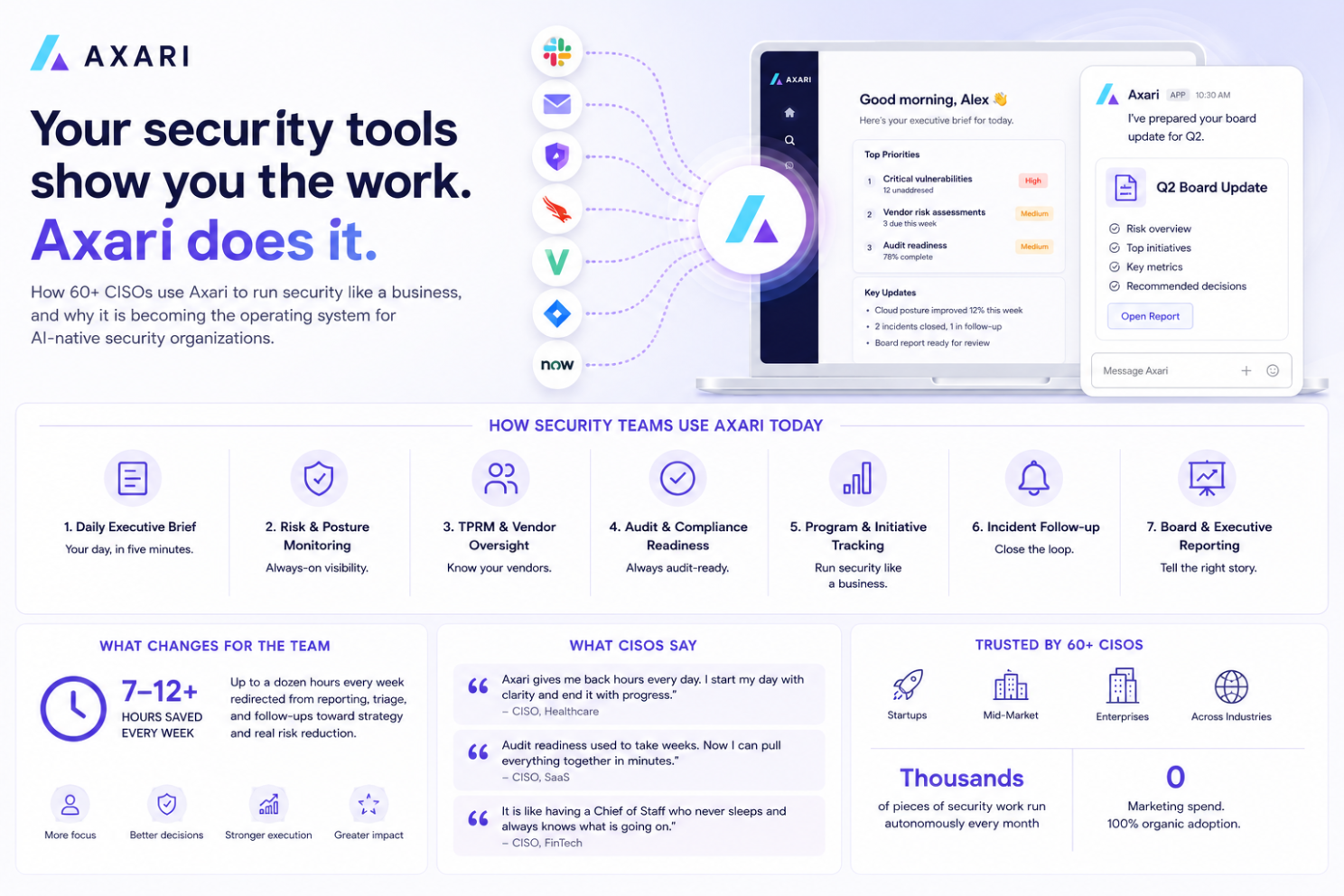
How security teams use Axari today
These are not roadmap promises. They are the use cases that 60+ CISOs and their teams run in production today.
Daily Executive Brief: your day, in five minutes. Every morning, Axari reads across email, Slack, tickets, calendars, and your security tools, and produces one prioritized brief of what matters most: top priorities and risks, the decisions you need to make, the key updates, and what can safely wait. Not an alert list. A narrative you can act on. Most leaders get 30 to 60 minutes back before the day even starts.
Risk and Posture Monitoring: always-on visibility. Axari continuously watches controls, vulnerabilities, misconfigurations, and program health across your stack, and surfaces your posture score, drift and gaps, emerging issues, and the trend over time. The result is a shift from reactive to proactive. You act on risk before it becomes an incident.
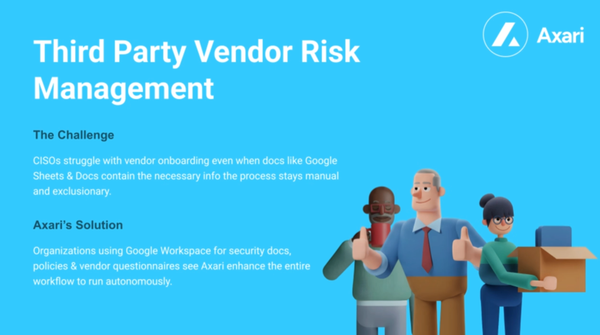
TPRM and Vendor Oversight: know your vendors. Vendor risk reviews, security questionnaires, assessments, SLAs, and renewal obligations are some of the heaviest, most thankless work in security. Axari tracks all of it, ranks vendor risk, keeps assessment status current, and flags upcoming renewals, so third-party exposure stops slipping through the cracks.
Audit and Compliance Readiness: always audit-ready. Axari maps controls, collects evidence across your systems, tracks exceptions, and assembles audit packages on demand. Teams that used to lose weeks to audit prep cut that time by more than 70 percent and walk into any audit with confidence.
Program and Initiative Tracking: run security like a business. Strategic initiatives, OKRs, project status, owners, risks, and deadlines all in one living view. Axari keeps initiative status real-time, surfaces risks and blockers, and holds owners accountable, so strategic outcomes actually land instead of drifting.
Incident Follow-up: close the loop. Incidents do not just get closed. Axari drives the follow-up: tracks action items, monitors remediation status, captures lessons learned, and helps prevent the same issue from recurring. That is the difference between resolving an incident and getting stronger because of it.
Board and Executive Reporting: tell the right story. Axari turns complex security data into concise, executive-ready reports and board decks, with QoQ trends, a risk heat map, the top risks, and clear decision support. The board conversation moves from scrambling for data to communicating impact with clarity.
What changes for the team
When you add it up, security leaders get back 7 to 12 hours every week. That is up to a dozen hours, every week, redirected from reporting, triage, and follow-ups toward strategy and real risk reduction.
But the change is not only about time. It is about the shift in how the work feels.
"Axari gives me back hours every day. I start my day with clarity and end it with progress." — CISO, Healthcare
"Audit readiness used to take weeks. Now I can pull everything together in minutes." — CISO, SaaS
"It is like having a Chief of Staff who never sleeps and always knows what is going on." — CISO, FinTech
This is happening at real scale. More than 60 CISOs across startups, mid-market, and large enterprises use Axari today, running thousands of pieces of security work autonomously every month, and all of it grew with zero marketing spend. The adoption is organic because the value is immediate.
Why this matters: from AI assistants to AI-native organizations
Here is the bigger picture, and the reason we built Axari the way we did.
The first generation of AI created assistants. They respond to requests and help individuals. The second generation creates digital coworkers that work alongside you, take on tasks, and drive outcomes. The third generation, the one we are building toward, will create AI-native organizations, where AI and humans run the organization together and the outcomes compound.
Security is going to make that transition, and Axari is the operating system that gets you there.
In an AI-native security organization, humans provide judgment, leadership, and accountability. Each leader gets a Twin that gives them personal leverage and intelligence tuned to their role. The organization shares Teammates that coordinate execution across teams and workflows. Underneath sit specialized security agents that execute domain-specific work across risk, compliance, vulnerabilities, vendors, and operations. All of it rests on institutional memory that preserves how your organization actually runs, the decisions, the patterns, the lessons learned, and an enterprise AI layer that makes every layer better over time through learning and feedback.
Together, those layers become a Security Operating System. More context leads to smarter execution, which leads to better outcomes, which leads to a stronger organization. And critically, each layer compounds the value of the layer below it. The longer Axari runs in your environment, the more it understands your people, processes, and tools, and the harder it becomes to imagine operating without it. That institutional memory is the part no tool, copilot, or generic assistant can replicate, because it is built from your organization, not a model.
Why you should use it
If your team is excellent but stretched, if your tools generate more signal than your people can possibly action, if audit prep still eats weeks and board prep is a scramble, the problem is not your stack. It is the operational layer on top of it. That is exactly the layer Axari runs.
Start with one person and the daily brief. Let it expand to the workflows your team dreads. Watch it grow from saving time into owning whole functions. And as it learns how your organization actually operates, it becomes the operating system for your security team, the place where intelligence, execution, and outcomes compound over time.
Security teams should not spend their best hours on busywork. With Axari, they do not have to.
Run security like a business. Less busywork. More impact.
Want to see what Axari would do in your environment? Reach out at axari.ai and we will show you the work, live!