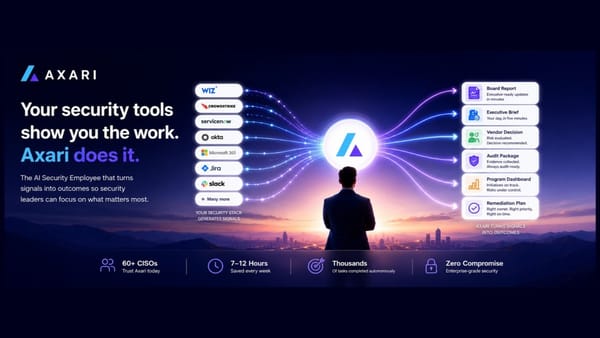

Most security programs don't fail for lack of skill. They fail because a handful of people can't hold the entire operational surface in their heads while making the decisions only they can make. This walkthrough follows a CISO at a 400-person healthcare SaaS company with a team of four, through one week with Axari. The CISO's scarcest resource isn't tooling or data. It's attention, and Axari is built to protect it.
By 5:40 a.m., before email or Slack, the CISO has a personalized briefing, not a dashboard to decode: three decisions that actually need a human, including two vulnerabilities past SLA and a Datadog contract auto-renewing in 10 days, the kind of deadline that vanishes the moment the vendor risk lead goes on leave.
From there, the AI workers absorb the work that normally consumes a small team:
- Suzanne (threat intel) doesn't just surface a critical RCE (CVSS 9.8, on CISA's known-exploited list). She maps it to the tech stack, isolates the two affected services (one internet-facing, one processing PHI), confirms the live exploit, and drafts the Jira ticket. A two-hour investigation becomes a decision the CISO simply ratifies.
- The Chief of Staff translates that vulnerability into board language minutes before a prep call, collapsing three hours of prep into three.
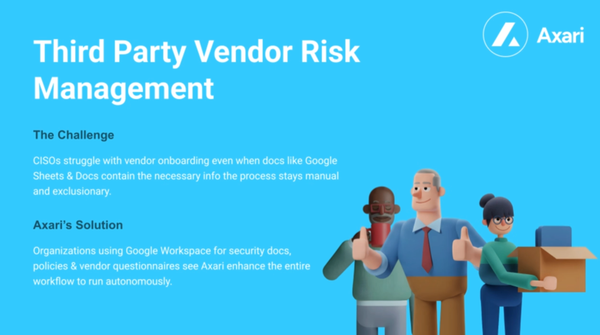
- Ria (vendor risk) catches the Datadog auto-renewal before the window closes and drafts the email demanding an updated SOC 2 report as a condition. One click. Without an owner, that contract renews with no security evidence.
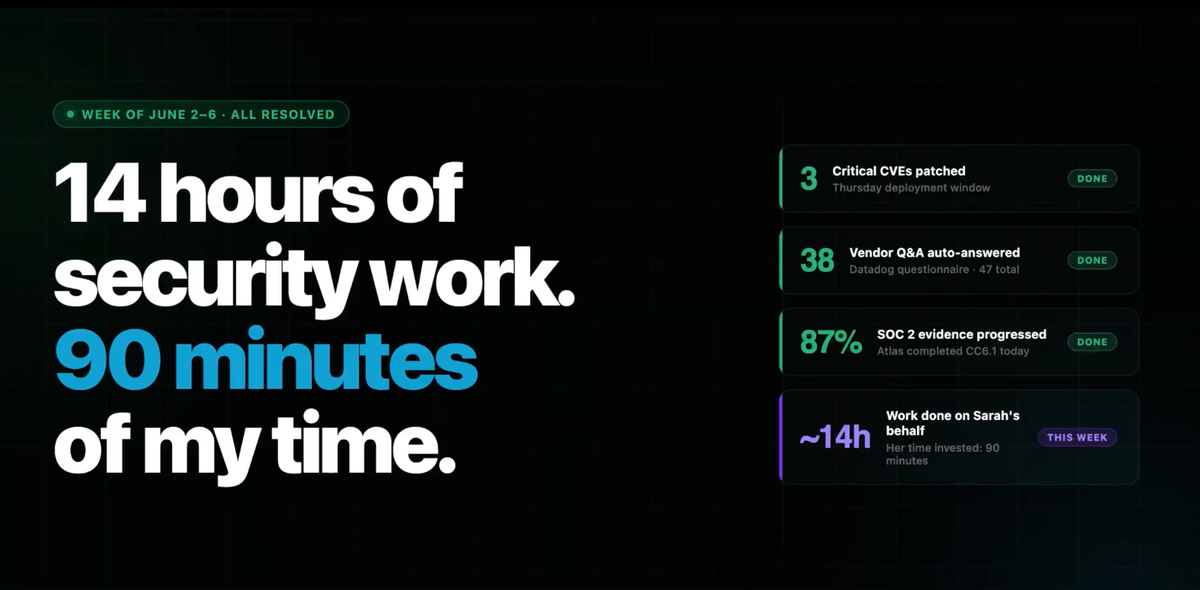
By Friday, the recap assembles itself: three critical vulnerabilities patched, the renewal handled, SOC 2 evidence at 87%, a NIST 2 policy drafted, the board update sent. Roughly 14 hours of work completed for the CISO, against about 90 minutes spent deciding.
That ratio is the argument. Axari doesn't make a four-person team work harder. It changes what the leader spends judgment on, shifting them from chasing deadlines to the decisions that genuinely require a CISO. The CVE that could have been missed, the renewal with no owner, the afternoon-long board prep: these aren't time savings. They're the failure modes that sink under-resourced security programs, and removing them lets a small team operate like a much larger one.