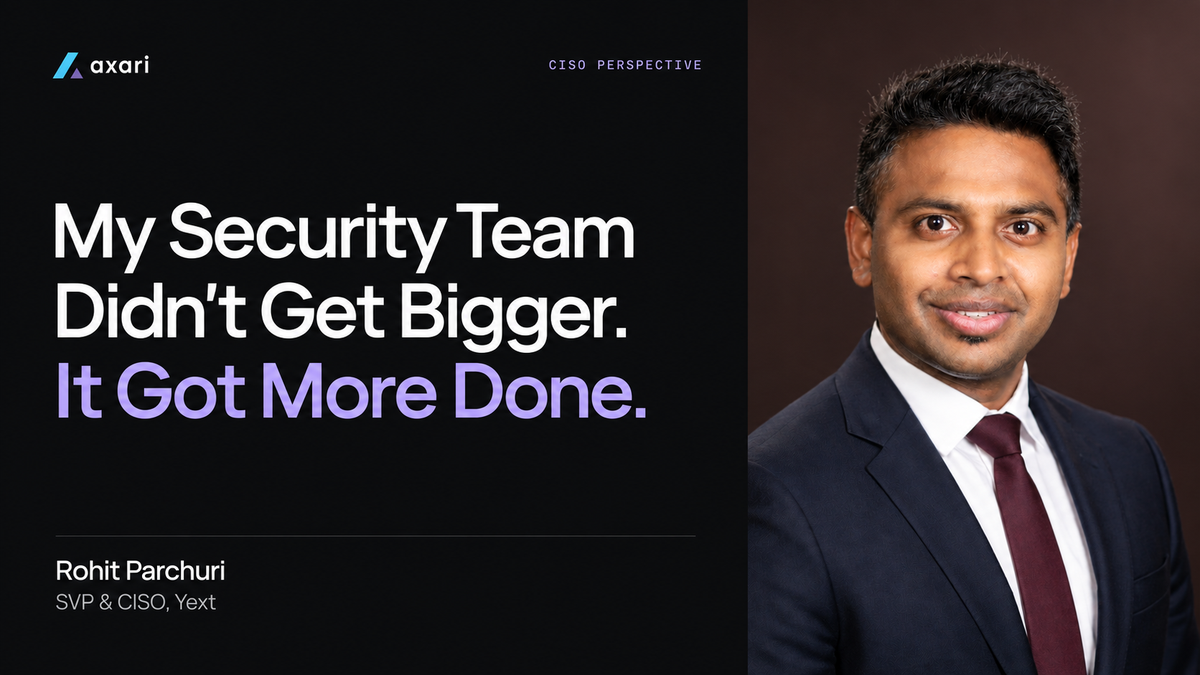

By Rohit Parchuri, SVP & CISO, Yext
I have been in the CISO seat long enough to know what the real problem is. It is not the alerts. It is not the policies. It is everything that happens between making a decision and confirming it is actually done.
Security programs run on follow-through. And follow-through is where most programs lose steam.
At Yext, we run a serious security operation with a team that does not have infinite capacity. Like every security organization, we carry more open work than we can actively chase. Remediation commitments age out. Vendor reviews slip. The same ticket gets looked at three times before anything changes.
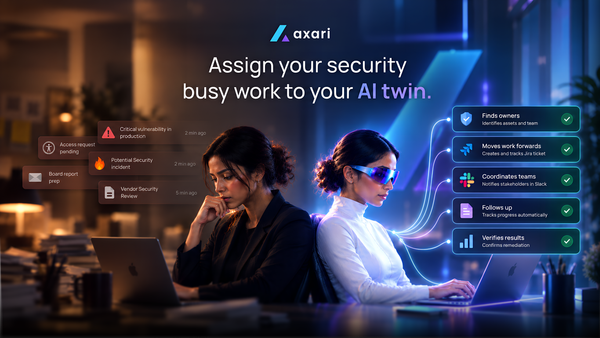
When I started working with Axari, I was not looking for another tool to add to the stack. I was looking for something that could carry the operational layer between the security decisions we make and the outcomes we need, while helping set expectations with the stakeholders involved.
What changed immediately was the follow-through. Axari watches the environment, tracks what is in flight, and surfaces the things that actually need attention.
I have seen this in action when Axari flagged an API finding that our team had classified as a false positive, but turned out not to be. It was able to do that because of the context it carries across the work.
Another core use case for me is something security teams rarely have enough time to do: continuously evaluate whether our existing controls are still effective, still necessary, and worth the operational burden.
A control that made sense two years ago may be redundant today because newer controls have been introduced. Yet we often continue carrying the cost and complexity simply because nobody has the time to continuously reevaluate it. Axari helps monitor those controls and evaluate their value against the operational burden they create.
And that gets to the bigger point.
The outcome matters more than the individual actions inside the tools.
My team has not grown. But more of the work we decide matters actually reaches the outcome we intended. Tickets that used to age in the queue now move. Vendor check-ins happen on schedule. Standing workflows continue even when the team is heads-down somewhere else.
For any CISO evaluating AI, I would not ask whether it can perform an impressive action in a demo.
Ask whether it can stay with the work, across people and tools, until the security outcome is actually achieved.
That is where this earns its place.
Axari does not replace security judgment. It makes sure that judgment turns into outcomes.
Rohit Parchuri is Senior Vice President and CISO at Yext.